
Why spelling comes first in learning to read
Many people think spelling is simply about writing words correctly. In reality, spelling plays a powerful role in learning to read.
“Spelling supports reading because it cements knowledge of how words are represented.” — Louisa C. Moats
Linguistic literacy brings that principle to life. By teaching children to listen first, connect sounds to symbols, and recognize the patterns that make English logical, we move them beyond memorization to mastery. Spelling becomes the gateway—not the obstacle—to fluent reading, confident writing, and a lifelong love of language.
Reading begins with the ears
Most people assume reading begins with the eyes, but it actually begins with the ears. Children learn spoken language naturally by listening to sounds long before they ever see print. In Evidence-Based Literacy Instruction (EBLI) and other linguistic literacy approaches, spelling is taught from speech to print–beginning with the sounds children naturally say and hear, rather than letter names or memorized rules.
Spelling can seem puzzling at first. Even adults who read well often describe themselves as poor spellers, and children can feel the same frustration. But decades of research–and classroom results from EBLI–show that spelling is far more than a writing skill.
The brain stores words most efficiently when children actively analyze and spell them. When children break a word into its individual sounds and connect those sounds to letters, the word becomes securely stored in memory for quick recognition during reading. As those sound-to-print connections become clear, reading begins to flow naturally.
That is why, in EBLI, spelling is not treated as a separate subject. It becomes the engine that drives fluent reading and confident writing.
Why reading and spelling are two sides of the same coin
Louisa Moats explains that reading and spelling “build and rely on the same mental representation of a word.” When a child learns how sounds connect to their spellings, the brain builds a strong mental memory of that word—one the child can both recognize while reading and reproduce while writing.
Sound Mapping: how spelling builds reading
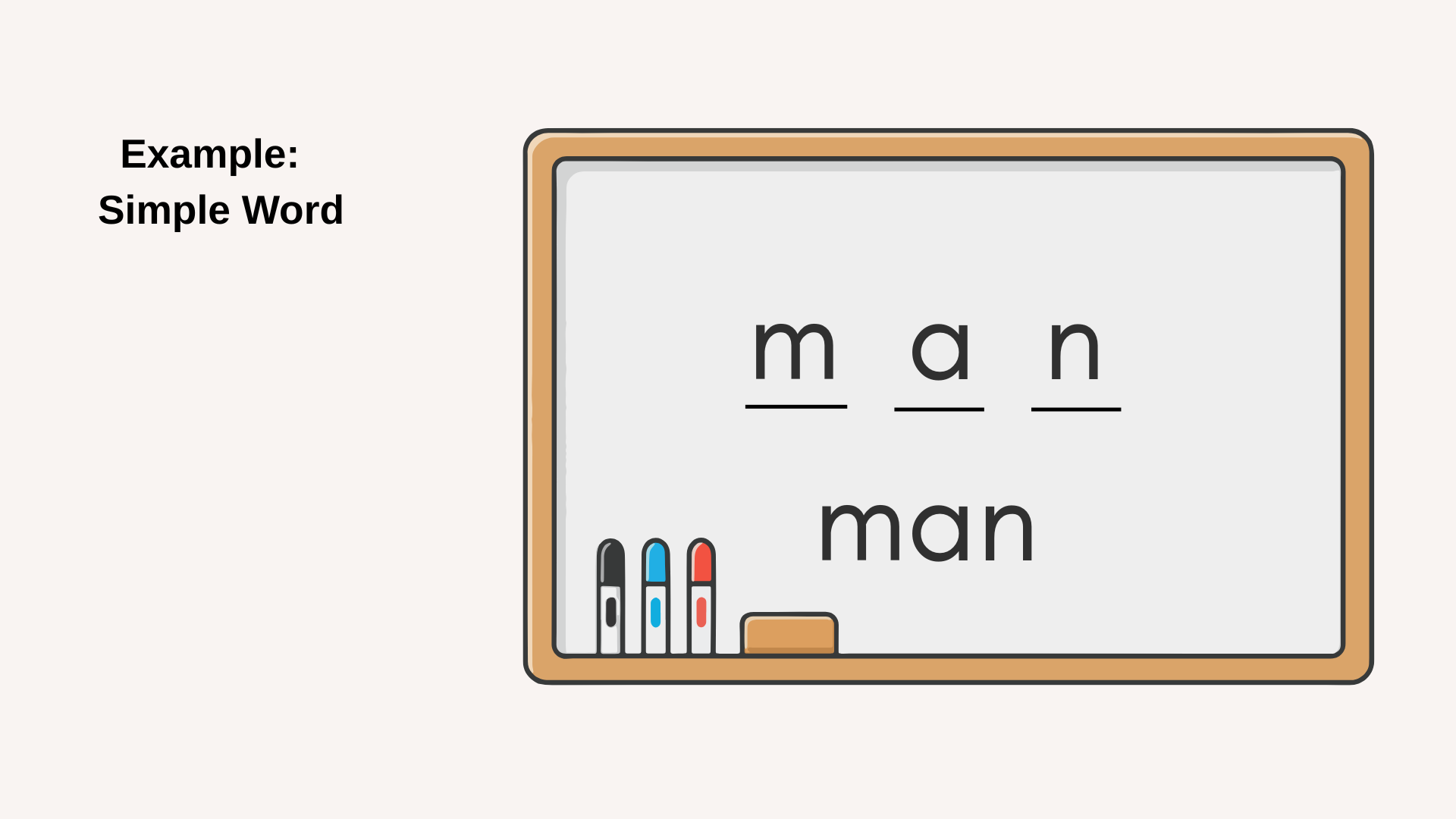
EBLI develops this connection through sound mapping. In a “say and pull” activity, students first listen for the individual sounds in a word, then match each sound to its spelling. As they pull each spelling down to a sound line, the lines act as a visual framework for mapping sounds to print in a systematic, sequential way.
After building the word, the student reads it and then says each sound again while writing the word as it would appear in normal text.
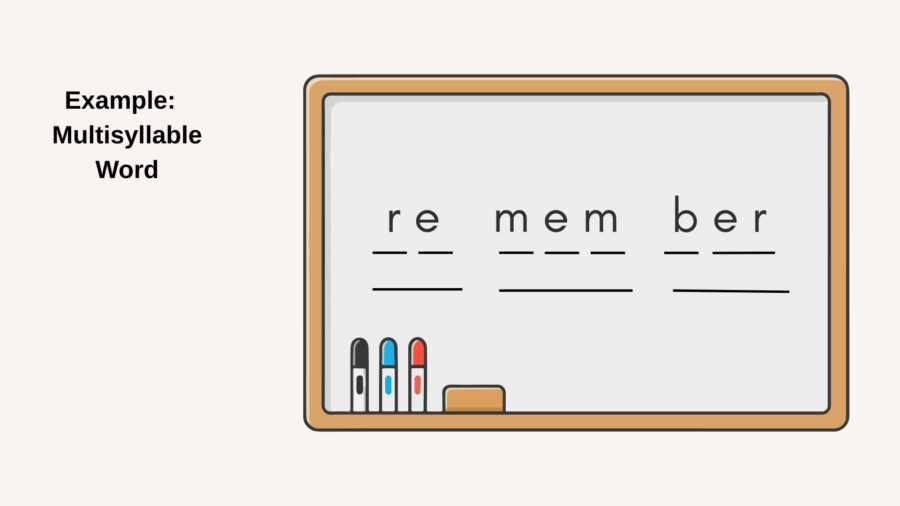
As students progress, the activity expands to multisyllable words. Students mark a line for each syllable, with smaller lines above for the individual sounds within each syllable. As they write, they continue to say each sound, reinforcing the sound-to-print connections that support both spelling and reading.
Through this process, students are not memorizing words–they are learning the system behind them. Spelling becomes the pathway that allows reading to develop naturally.
Why “Say as you write” matters
It is not enough for children to simply look at a word or copy what they see. At Brilliant Futures Tutoring, we intentionally dictate the word, then ask students to say each sound aloud as they write—and there is a powerful, brain-based reason behind this practice.
When students say each sound at the exact moment they write it, the brain links:
- what the child hears
- what the child says
- what the child writes
- what the child sees
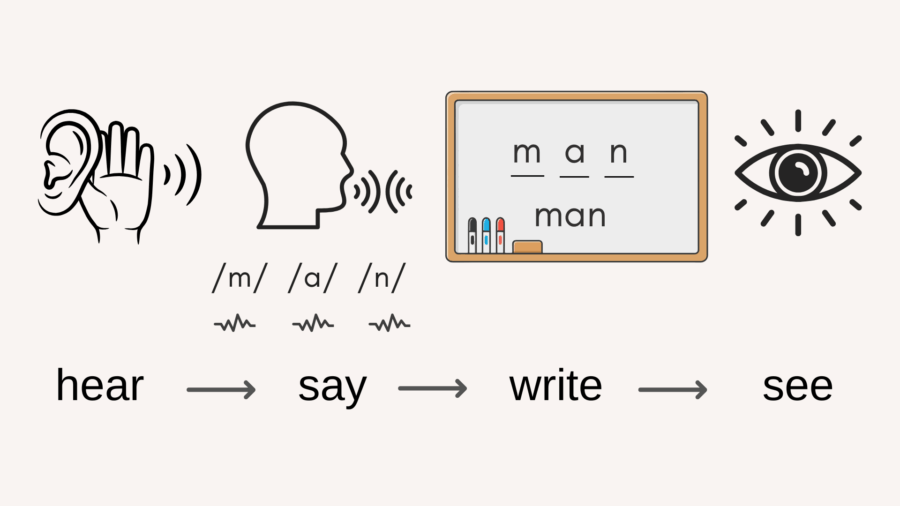
This synchronization activates both the brain’s reading and spelling networks at the same time, strengthening memory and building automatic word recognition. The child is actively connecting speech to print—the foundation of lasting literacy.
Crucially, the child must produce the sounds independently rather than simply listening to what an adult says. When a tutor or parent supplies the sounds, the child may appear successful, but the brain is doing less of the work. When the child generates the sounds themselves, they are actively retrieving, sequencing, and encoding information—leading to learning that is deeper and far more durable.
That is why we treat “say as you write” as an essential habit, not an optional add-on. It transforms spelling from a copying task into an active, multisensory learning process, where hearing, speaking, seeing, and movement work together to make reading and spelling truly stick.
Listening before looking: how EBLI starts with sound
EBLI and other linguistic literacy methods begin where language truly lives—in speech. Students don’t start with letter names or phonics rules; they start by hearing, identifying, and sequencing the individual sounds in whole words.
Letter names can actually interfere with spelling because they rarely match the sounds letters make. For example, the letter w never says /double-u/, y never says /why/, and t never says /tee/.
One activity that reinforces this process is Listen-Tally-Say-Write (LTSW). Students:
- Read a word, with support as needed.
- Identify each sound in the word.
- Tally the number of sounds.
- Say each sound aloud in order.
- Write the spellings for each sound at the same time the sound is spoken.
This single activity develops reading, spelling, phonemic awareness, phonics, vocabulary, and handwriting simultaneously. Children are not memorizing words; they are building the language network in their brains.
English spelling is logical—once you see the patterns
Dr. Louisa Moats’ research found that about 84 percent of English words are predictable once you understand their sound-spelling patterns and word origins. EBLI helps students see and hear these patterns automatically so that spelling and reading become logical instead of mysterious.
Common Patterns Students Explore
Patterns that students become familiar with include:
- The most common spelling for the sound /shun/ is -tion (nation, action, fiction).
- The most common spelling for /s/ at the end of a word is -ce (face, peace, race).
- A double consonant before a single vowel usually signals the vowel’s short common sound (batting, pepper, dinner, hopping, puppy).
- The sound /ee/ can be spelled many ways–as in: He dreams of cookies and sees a happy trio.
From most common to least common, the vowel team ea represents:
- /ee/ as in dream, read, beach
- /eh/ as in bread, head, feather
- /ay/ as in great, steak, break
Seeing the patterns instead of memorizing the rules
Recognizing and comparing these sound-spelling patterns turns what used to feel like random rules into meaningful logic. Instead of memorizing disconnected word lists, children learn to analyze, reason, and apply. They begin to understand that English spelling is not chaotic; it is logical, layered, and learnable.
Research confirms the power of spelling
Research confirms what EBLI classrooms demonstrate every day: children who practice spelling from sounds to print develop stronger reading fluency and comprehension.
In a large multi-year study highlighted by Dr. Louisa Moats, reading comprehension stayed average while spelling scores dropped sharply after second grade when spelling was not explicitly taught. This finding shows that reading instruction alone does not ensure strong spelling, and without spelling, reading progress eventually stalls.
A natural progression of skills
Dr. Louisa Moats outlined a clear developmental sequence for how reading and spelling skills typically unfold over the elementary years, from sound awareness in kindergarten to Latin and Greek roots in the upper grades.
| Stage | Typical Focus of Instruction |
| Kindergarten | Hearing and identifying sounds (phoneme awareness); connecting each sound to print |
| Grade 1 | Mapping common sound-spelling correspondences |
| Grades 1-3 | Learning high-frequency and irregular words through rule- and pattern-based practice |
| Grades 2-3 | Adding inflectional endings (-s, -ed, -ing); learning doubling and drop-e patterns |
| Grades 3-4 | Working with multisyllable words, schwa, compounds, prefixes, and suffixes |
| Grades 4-6 | Exploring Latin roots and affixes (dict, port, spect) |
| Grades 6-7+ | Studying Greek combining forms (photo, graph, bio, thermo) |
How EBLI accelerates this process
EBLI follows the same foundational logic but at a faster, more integrated pace. Because students are taught through speech-to-print instruction, they move fluidly between reading and spelling from the very beginning.
Even in Kindergarten and Grade 1, EBLI students are exposed to:
- Multiple spellings for a single sound (rain, may, cake)
- The same spelling representing different sounds (read, bread, great)
- Multisyllable words broken down by sound and pattern
- Simple prefixes and suffixes such as re-, dis-, -s/-es, -ed, and -ing
- Compound words and other real-word structures that show how English words connect
Because reading and spelling are embedded in every activity rather than taught separately, students practice decoding and encoding simultaneously. This integration accelerates progress, enabling children to read and write more complex words much earlier while solidifying their understanding of how sounds, spellings, and meanings interact.
EBLI compresses years of traditional instruction into a cohesive, sound-to-print framework that builds reading and spelling mastery simultaneously.
Simple ways to support reading and spelling at home
Sound it out first. Ask, “What sounds do you hear in ship?” Have your child tally the sounds, then say each sound as they write it.
Spot patterns. Notice groups of words that share the same ending, such as nation, action, and motion, and talk about what that ending means. This helps your child recognize that spelling patterns often carry meaning.
You can also dictate words in patterns to make the connection stick:
- Write -tion at the top of a whiteboard.
- Say, “We are going to practice the suffix -tion.”
- Dictate words that end with -tion (nation, frustration, creation, mention, donation, etc.).
- Have your child identify the chunks or syllables, not by how a dictionary divides them, but by how the parts naturally fall out of their mouth. For example: na-tion, frus-tra-tion, cre-a-tion, men-tion, do-na-tion.
Sometimes these chunks match dictionary divisions, and sometimes they don’t. For example: happy becomes ha-ppy, celebrate becomes ce-le-brate, beneficial becomes be-ne-fi-cial. The goal is not to memorize where syllable breaks belong, but to hear and feel the rhythm of spoken English, a key step in connecting sounds to spellings accurately and confidently.
Say while writing. Encourage saying each sound rather than naming letters.
Notice vowel signals.
- A single vowel followed by two consonants usually keeps its short common sound (rabbit, kitten).
- A single vowel followed by a consonant + e usually makes the vowel say its name (cake, bike, home, cube).
Helping children spot these vowel signals turns guessing into reasoning. Once they learn to look for these patterns, they can approach new words with confidence and accuracy.
Connect meaning. Example: show how sign and signature share spelling because they share meaning.
Small, frequent moments like these build powerful word awareness and long-term reading fluency. Just fifteen to twenty minutes a day of focused spelling, especially when integrated with writing, can transform both reading ability and self-confidence.
Use whiteboards for word work
Whiteboards reduce anxiety and encourage risk-taking. They feel fluid and forgiving, allowing students to focus on sounds, patterns, and meaning rather than fear of mistakes. A quick finger flick erases an error, turning correction into a natural part of learning instead of something to hide. This ease keeps the energy light and the learning active, helping students stay engaged, confident, and willing to try again.
Takeaways
- Phonics (decoding) and spelling (encoding) overlap. Both rely on understanding how sounds map to letters and letter combinations, linking what we hear to how words are written and read.
- “Good spellers aren’t born; they are taught.”
- “If a child can spell a word, they can usually read it.”
- 50% of words are purely phonetic, 40% are predictable with instruction, and only 10% are truly irregular.