Reading assessment in Prince George & online
The first step toward confident, fluent reading
Reading diagnostic assessment
A Reading Diagnostic Assessment is a one-on-one evaluation that gives a clear, detailed picture of a child’s current reading, writing, spelling, and phonemic awareness skills. Unlike general school assessments or quick screenings, a diagnostic assessment pinpoints exactly which underlying skills are strong, which are emerging, and which are causing breakdowns.
Think of it as a roadmap: before instruction begins, we establish a clear baseline of your child’s strengths and weaknesses so we can personalize lessons and efficiently target the areas that need support. Further Assessments will be conducted in future lessons.
After the assessment, if you decide to move forward with lessons, EBLI (Evidence-Based Literacy Instruction) strategies will be implemented to support growth across all areas of literacy: phonemic awareness, phonics, reading, writing, spelling, comprehension, vocabulary, and handwriting.
To monitor progress and ensure instruction remains precisely targeted, a minimum of two reassessments will be completed during the program:
- a mid-program assessment after Activity 70
- a final assessment after Activity 140
Most students complete the full EBLI sequence in one year or less, depending on consistency and individual needs.
What it measures
Our detailed reading diagnostic assessment evaluates:
Automaticity – whether skills are effortful or effortless, and which areas need strengthening.
Phonemic awareness – how well your child can hear, pull apart, and manipulate the sounds in words (the #1 predictor of reading success).
Decoding/reading accuracy – how your child reads words, including how they handle multiple spellings for sounds.
Spelling/writing patterns – which patterns they know, which they guess on, and whether they rely on memorizing letter names instead of sounds.
Reading fluency – pace, accuracy, and how smoothly they read connected text.
Why it’s important
A diagnostic assessment:
- Identifies the root cause of reading struggles (not just the symptoms).
- Prevents wasted time—your child won’t repeat skills they already know.
- Guides targeted, efficient instruction, especially in EBLI and linguistic-literacy-based tutoring.
- Provides a benchmark so progress can be clearly measured over time.
- Helps set realistic goals and expectations for the pace of improvement.
How it helps parents
After the assessment, you receive:
- A detailed written report of what your child can do well
- A detailed outline of the skills that need strengthening
- A personalized plan for how tutoring with EBLI will address those gaps
- An understanding of the expected timeline for progress
Parents often share that this is the first time they’ve seen their child’s reading broken down so clearly and logically.
Components of our reading diagnostic assessment
Our reading assessment has the following components:
- Handwriting: alphabet exercise
- Phoneme segmentation
- Word reading fluency
- Oral reading fluency: passage reading
- Spelling
- Writing
You’ll receive a detailed written report that clearly explains your child’s strengths and areas for growth. We’ll also schedule a 15-minute conversation to walk through the results together and answer any questions you may have.
1. Handwriting: alphabet exercise
1-Minute timed handwriting-alphabet exercise
Goal: 40 letters per minute: a-z + a-n
- Letters are in order
- All lower case
- Letters formed top to bottom
During the timed assessment, students are unassisted by their tutor but are free to recite ABC’s to themselves.
While monitoring letter formation during the alphabet exercise, the tutor also assesses posture and pencil grip which can impact ease of handwriting, especially for an extended period of time.
Why handwriting matters for reading success
Many parents are surprised to learn that handwriting isn’t just about neat penmanship and legibility—it actually plays a big role in reading fluency and comprehension. One key reason is motor planning, the brain’s process for learning how to perform a new action.
The goal of handwriting instruction isn’t just legibility—it’s to help students build motor memory that frees up brainpower for thinking, understanding, and learning.
What is motor planning?
Motor planning helps us carry out movements—like riding a bike or writing letters. In handwriting, it involves planning, sequencing, and executing the shapes of letters so that they come together to form words. This process uses many muscle groups working together with just the right force and timing.
With repetition, motor planning develops into motor memory, where the brain stores the new action in its long-term memory and the action becomes automatic.
“Motor planning creates the initial blueprint, and repetition solidifies it into motor memory, enabling effortless execution later.”
Why it matters for struggling readers
When a child has poor motor planning, handwriting can be slow, awkward, or tiring. This not only affects their writing but also disrupts focus and attention, which can impact reading and overall learning. The good news is that improving handwriting improves focus, and over time, supports stronger reading fluency and comprehension.
Building motor memory that frees up brainpower for thinking, understanding, and learning. With the right instruction and repeated practice, the brain develops a motor plan for how to write letters and words. Eventually, this process becomes automatic. Once handwriting is automatic, students can focus more easily on what they want to say or read, rather than how to form the words.
The connection between writing the alphabet and reading fluency
Research shows a strong correlation between a student’s ability to write 40 lowercase letters of the alphabet in one minute (cycling through all 26, then restarting at a) and increased oral reading fluency, comprehension, and focused, organized writing.
Criteria for the alphabet writing task
- Letters are in order
- All lower case
- Letter formation moves top to bottom, left to right.
(This includes crossing letters f and t from left to right, drawing the short leg of the letter y first (then the long leg), and drawing the first slant of the letter X in the direction we read and write (\ then /).
Direction matters
We insist on top-to-bottom, left-to-right strokes because that is the same direction we use when reading. Practicing efficient handwriting reinforces the brain processes needed for smooth, fluent reading.
Correlation between alphabet writing exercise and oral reading fluency
Because both tasks depend on automatic access to letter knowledge.
- Writing the alphabet in sequence requires students to retrieve and produce letters rapidly and in the correct order—a foundational skill for fluent reading.
- If students struggle to recall or write letters automatically, it slows down both their writing and their ability to decode and read words smoothly.
This simple task—writing all the letters in alphabetical order—gives insight into how efficiently a child’s brain can access and use written language.
How does EBLI build handwriting automaticity?
If a student demonstrates weakness with the timed Handwriting Assessment, 1–3 minutes of each lesson will be dedicated to practicing the lowercase alphabet a–z with attention to consistent and accurate letter formation and letters in alphabetical order. The practice sessions are untimed and the tutor provides support as needed to form the letters correctly and in the recitation of the alphabet. Once significant progress is observed, the 1-minute timed assessment will be re-administered. With practice, not only is the timed goal achieved but legibility also improves.
2. Phoneme Segmentation
One key goal of early reading instruction is to help children hear and identify the individual sounds—or phonemes—that make up spoken words. The phoneme segmentation task is used during diagnostic assessments to measure this skill.
What is phoneme segmentation?
Phoneme segmentation is the ability to break a word apart into its individual sounds. For example, the word cat has three phonemes: /k/ /a/ /t/. A child who can hear and say each of these sounds separately is showing an important skill that supports both reading (decoding) and spelling (encoding).
Why it’s important
Phoneme segmentation is a critical building block for reading and writing. Students must be able to isolate and manipulate sounds in words to:
- Blend sounds together to read new words
- Break words apart to spell them correctly
- Recognize patterns in sound-symbol relationships
Weak phoneme segmentation often shows up as trouble sounding out unfamiliar words, guessing while reading, or making frequent spelling errors.
What we’re looking for
This assessment helps us determine whether a student can:
- Hear the separate sounds in words
- Say those sounds in the correct order
- Work with sounds independently of letters
How does EBLI grow phonemic awareness?
Students who struggle with this skill benefit greatly from targeted instruction to strengthen their phonemic awareness. Being able to clearly hear and differentiate the individual sounds in spoken words is foundational for becoming a confident, accurate, and fluent reader. It’s also a skill we can absolutely help your child build.
This is one more area where EBLI (Evidence-Based Literacy Instruction) truly shines. Instead of relying on memorization—something that can feel overwhelming given how complex and unpredictable English can seem—EBLI teaches students how to break words into sounds and use practical, flexible strategies for both reading and writing. These tools give students a clear, logical path forward and take the guesswork out of decoding and spelling.
3. Word reading fluency — grade level reading assessment
The San Diego Quick Assessment (SDQA) is a word identification test used to determine a student’s approximate reading grade level. The independent reading level determined by the assessment will be used to determine the grade level for the passage reading assessment in step 4.
How does EBLI boost word reading fluency?
EBLI raises word reading fluency, and subsequently reading grade level, by rapidly strengthening the skills that have the greatest impact on real-world reading: accurate decoding, flexible word solving, comprehension, and written language. Instead of moving slowly through “levels” or rule-based phonics, EBLI helps students build efficient reading skills quickly, so they can advance into higher-level texts sooner.
1) EBLI fixes the root skills, not the symptoms
Struggling readers don’t fall behind because they need more practice reading slowly—they struggle because they can’t accurately recognize and process words. EBLI solves this by teaching students how to:
- hear every sound in a word in order
- map those sounds to letters logically
- solve unfamiliar words without guessing
Once decoding is strong, grade level naturally jumps because students finally have the core skill needed to read real text.
Grade level doesn’t rise from harder books—it rises from stronger word solving.
2) Students move quickly into real reading
Many approaches delay authentic text until students “master” sets of rules or levels. EBLI does the opposite:
- students read real sentences immediately
- they read real texts long before traditional programs would permit it
- texts are not limited to narrow “decodable” patterns
This rapid entry into meaningful reading accelerates vocabulary, comprehension, and exposure to advanced language—key drivers of grade-level growth.
3) Writing boosts reading grade level
EBLI constantly links reading and writing.
Students write words, sentences, and short paragraphs using sounds first, then spellings, which strengthens:
- phonemic awareness
- word recognition
- grammar and sentence structure
- organization and clarity of ideas
Writing reinforces reading so powerfully that it pushes students into more complex reading sooner.
Better writing equals better reading—and higher grade level.
4) EBLI reduces cognitive load so students learn faster
Traditional programs often slow progress with:
- dozens of rules
- syllable-type memorization
- controlled text sequences
- rote practice drills
EBLI removes unnecessary cognitive clutter. Students learn:
- one flexible, logical process that works for all words
- patterns through use, not memorization
- comprehension from the start
When learning is simple, brain-aligned, and efficient, students accelerate—often rising multiple grade levels in a short time.
5) Comprehension & vocabulary are taught early & often
Grade level is not just about decoding—it’s also about understanding increasingly complex ideas.
EBLI integrates comprehension from the start:
- summarizing
- synthesizing
- vocabulary through real text
- meaning checks every step of the way
Students don’t just “sound better”—they understand more deeply.
Reading grade level is measured by both skills and meaning. EBLI builds both at once.
The Result: Faster, Lasting Growth
EBLI raises grade level quickly because it:
- fixes the foundational skills that limit progress
- gets students into real text early
- links reading and writing
- reduces cognitive load
- builds comprehension at the same time
Students using EBLI generally grow 1–3 grade levels in a single year, not because they work harder, but because they finally learn the way the brain is wired to read.
4. Oral Reading Fluency: Passage Reading
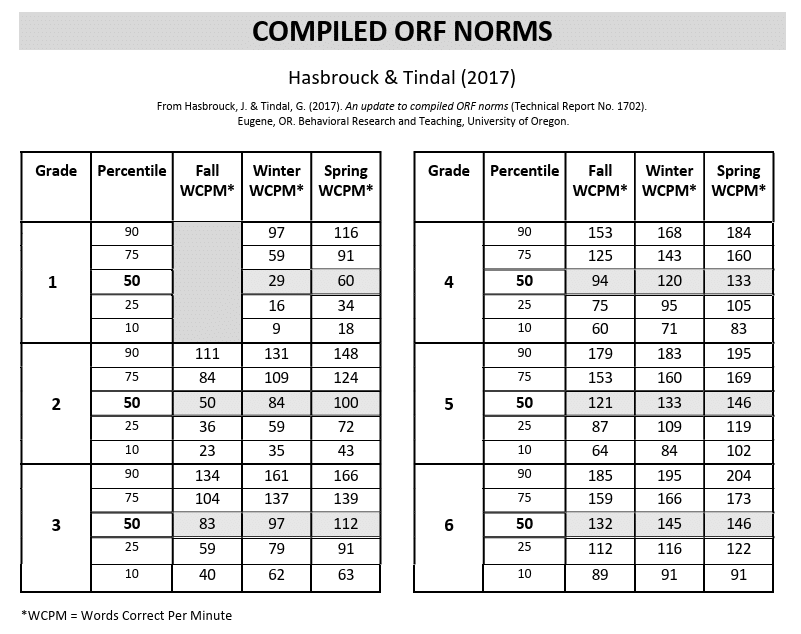
We use Easy CBM (Curriculum Based Measurement) norm-referenced standardized test to conduct 1-minute timed reading assessment of a grade level passage (previously determined by the results of the San Diego Quick Assessment word identification test).The goal of oral reading fluency is reading smoothly, evenly, and with natural expression, pausing appropriately for punctuation like commas and periods.
Fluent reading means the student is not only reading at a reasonable pace but also understanding what they’re reading, which is essential for strong comprehension. As fluency improves, reading becomes more enjoyable and less effortful, allowing students to focus on meaning rather than decoding each word.
Rough oral reading fluency guidelines
How does EBLI build oral reading fluency?
EBLI builds fluency from the inside out. Instead of teaching children to read faster by practicing speed alone, EBLI strengthens the skills that make fluent reading possible: accurate decoding, flexible word solving, strong sentence reading, and meaning-making. When those foundations are built, fluency comes naturally.
1) EBLI Starts with Accurate, Flexible Decoding
Students learn to:
- pull apart sounds in whole words
- map those sounds to spellings quickly
- use logic—not guessing—to solve unknown words
Because they aren’t guessing from pictures, first letters, or “rules,” they read more accurately, which automatically improves fluency.
You can’t read fast if you’re constantly uncertain. EBLI removes the uncertainty.
2) EBLI Teaches Whole-Sentence Fluency Early
Instead of slow, letter-by-letter practice, students read real words in real sentences from the very beginning.
They practice:
- reading whole phrases
- pausing at punctuation
- grouping words in natural chunks
This builds fluency as a speech skill, not as a robotic speed skill.
3) Writing Words Builds Fluency
EBLI links reading and spelling constantly.
When students write words by sound (not by memorization or rules), it:
- strengthens phonemic awareness
- deepens sound–spelling patterns
- makes future reading nearly automatic
Writing improves decoding, and stronger decoding improves fluency.
4) EBLI Reduces Cognitive Load
Traditional programs overload students with:
- dozens of phonics “rules”
- rigid syllable types
- long, controlled lists far from real reading
EBLI teaches only what the brain needs: how to map sounds to print efficiently and flexibly. Spelling patterns are taught instead of memorizing lists of words or rules. Kids learn that there are multiple ways to spell a single sound, like /ee/ in He dreams of cookies and sees a happy trio. Also, there are multiple sounds for a single spelling, like <ea> in dream, bread, great. They also learn early that 1,2,3 or 4 letters can spell a sound. They are taught to flex sounds in words until they reach the correct pronunciation—just like proficient readers do!
When the process is simple and logical, the brain has more room for comprehension and expression—key components of fluency.
5) Meaning Comes First
Fluency isn’t true fluency without understanding.
EBLI constantly asks:
- What does that word mean?
- Does what you read make sense?
- Can you summarize what you read?
This builds purposeful reading—the kind of fluent reading we want for life, not just on a stop-watch.
The Result: fluency that is real and permanent
EBLI doesn’t teach students to read quickly; it teaches them to read accurately, efficiently, and with understanding. Speed becomes a by-product of:
- strong decoding
- flexible word solving
- connected writing
- sentence-level practice
- meaningful comprehension
That’s why EBLI students accelerate so quickly — even if they previously struggled.
5. Spelling Assessment
Reading and Spelling both rely on the same sound-to-symbol connections.
- Reading is receptive
- Spelling is expressive
Improved spelling often leads to stronger reading skills—because both rely on the same sound-to-symbol connections. When a student learns to spell words correctly, they are also reinforcing the decoding skills needed to read fluently and accurately.
Why spelling is more challenging than reading
Spelling is often more difficult than reading because it requires students to choose the correct spelling for each sound—and in English, most sounds can be spelled in several different ways. For example, the long “e” sound can be spelled ee, ea, y, ie, or ey. This makes spelling a more complex process than simply recognizing or reading a word.
Understanding the purpose of the spelling assessment
The purpose of this spelling test is not to determine how many words your child can spell correctly (like a typical school test). Instead, we are looking for patterns in the errors so we can clearly identify which skills or sound-to-spelling connections need to be taught.
In fact, we want the student to make mistakes—because that gives us the clearest picture of what’s missing or misunderstood. Multiple errors are not a sign of failure; they are essential for building an effective and targeted plan to help your child succeed.
How does EBLI support spelling?
EBLI spelling is effective because it is efficient, brain-aligned, and strategy-based. It mirrors how the brain naturally learns language. Instead of memorizing long lists of rules and exceptions, students start with the sounds of speech and learn the different ways those sounds can be written. This speech-to-print focus reduces confusion and makes spelling logical.
EBLI also integrates reading, spelling, handwriting, and vocabulary within each activity, which lowers cognitive load and helps skills transfer more quickly. Students use multisensory strategies—saying, hearing, writing, and seeing words—to strengthen memory and retention. Activities like Listen–Tally–Say–Write (LTSW) actively engage students, requiring students to actively listen, analyze, and write words rather than passively memorize them.
English spelling is complex but not random. EBLI teaches students to look for reliable patterns, which makes spelling logical rather than overwhelming. By focusing on patterns and problem-solving rather than rote memorization, EBLI builds confidence, independence, and lasting literacy skills.
6. Writing
Your child will be encouraged to write a sentence or a short paragraph, depending on their comfort and ability level. We’ll choose a topic together—something that interests them and feels manageable. If their anxiety rises or the task becomes overwhelming, we will gently pause for a brain break or shift away from the activity. The goal is to build confidence, not pressure.
This is the only time students are asked to write without helping them correct their writing.
How does EBLI develop writing skills?
As part of students’ reading instruction through EBLI (Evidence-Based Literacy Instruction), we will also be working on their writing—from crafting accurate sentences to building strong paragraphs and eventually longer written pieces. This is an intentional and important part of the learning process, not just an added skill.
1. Writing Builds Stronger Reading Skills
Writing helps reinforce the same skills needed for fluent reading. As students learn to spell words by connecting sounds to letters (encoding), they are strengthening the pathways in the brain that also help them decode words when reading. Writing also boosts their vocabulary, sentence structure, and comprehension—all essential for successful reading.
2. Step-by-Step Skill Building
EBLI teaches writing in a logical sequence:
- First, students learn basic decoding and encoding strategies for one-syllable and multi-syllable words
- Then, students write accurate sentences, from guided and dictated to independent writing
- Then, they build organized paragraphs, with explicit instruction
- Finally, they apply those skills to write longer pieces of text
This step-by-step approach ensures students gain confidence and clarity as they develop her writing and reading skills together.
3. Writing Reveals What Reading Might Hide
Sometimes, students are able to read a word but cannot spell or write it correctly. Writing helps us identify and address those hidden gaps in understanding. This allows us to give students direct, targeted instruction that helps them become a stronger reader and writer.
4. Real-Life Literacy
In everyday life, reading and writing go hand in hand. Whether students are reading directions, writing an email, or completing an assignment, they’ll need both skills to be successful. By integrating writing into reading instruction, we’re helping them build complete, real-world literacy.
As students practice reading and writing together, he will begin to approach both with more confidence, independence, and success. This integrated approach is one of the many reasons EBLI is so effective.
EBLI (Evidence-based literacy instruction)
What Is linguistic literacy?
Linguistic literacy—also called linguistic phonics or Speech-to-Print—is the foundation of EBLI’s instructional approach. It accelerates reading progress because it mirrors the true structure and logic of the English written code.
Traditional methods teach reading from print to speech—starting with letter names, syllable rules, and rote memorization of isolated patterns. Linguistic literacy reverses that process by beginning with the spoken sounds in words and mapping them to their spellings. This speech-to-print orientation is far more intuitive for the brain and reduces cognitive load dramatically.
Students are introduced to authentic texts early, not confined to predictable, controlled readers. As a result, they build real fluency, confidence, and critical thinking from the start.
Why linguistic literacy is more effective
This approach streamlines learning by removing the clutter that overwhelms students in traditional programs:
- No spelling rules (or their many exceptions)
- No syllable rules
- No letter-name memorization
- No flashcard drills
- No weekly lists of words to memorize
Instead, students learn to hear sounds, pull words apart, and match sounds to their spellings using logical, flexible strategies. They learn patterns—exactly what the brain is wired to recognize and thrives on—so reading and spelling come more easily, feel more predictable and more manageable. This eliminates guessing from pictures, first letters, or context. Multiple reading skills—phonemic awareness, phonics, reading, writing, spelling, vocabulary, comprehension, and handwriting—are taught simultaneously, not in isolation, which further accelerates reading progress.
The four core concepts of EBLI
EBLI highlights four simple but powerful ideas:
1. Letters spell sounds.
- /l/ = l
- /b/ = b
- /m/ = m
2. A sound can be spelled with one or more letters.
- cat → /c/ /a/ /t/
- dish → /d/ /i/ /sh/
- right → /r/ /igh/ /t/
- weigh → /w/ /eigh/
3. A sound can have multiple spellings.
Example: the /ai/ sound:
- ai → brain, train
- a → came, table
- ay → play
- ey → they
- ea → great
- eigh → eight
4. A spelling can represent different sounds.
Example: the <ea> spelling:
- ea → dream
- ea → bread
- ea → great
The flexibility of English is taught directly so students can decode any word they encounter.
The Result
Because EBLI integrates skills and minimizes cognitive load, students experience:
- faster and more consistent reading progress
- increased confidence and independence
- clearer understanding of how English actually works
- reduced frustration and greater engagement
- measurable growth across decoding, fluency, spelling, and comprehension
Every learner receives individualized instruction tailored to their needs so they can reach their full reading, writing, and spelling potential.
Reviews