Understanding the Orton-Gillingham approach
Does it line up with modern neuroscience and linguistics?
Why Linguistic Literacy is changing reading instruction
Orton-Gillingham method of instruction
For decades, the Orton-Gillingham (OG) approach has shaped the landscape of effective reading instruction. If you’re a parent researching support for a struggling reader, you’ve almost certainly encountered OG in your searches—and there’s good reason. OG is widely respected, research-informed, and has helped many children, especially those with dyslexia, make meaningful progress.
OG was originally developed in the 1920s–1930s by neuropsychiatrist Samuel Orton and educator Anna Gillingham. It was designed specifically to help individuals with dyslexia, but is now used in many general education and intervention settings.
Dr. Samuel Orton’s pioneering work in the 1920s and 1930s was instrumental in identifying word reading difficulties, particularly those now known as dyslexia. His research highlighted the challenges some individuals face in reading, and these insights laid the foundation for what would become a major area of study and intervention in reading difficulties.
Building on Orton’s work, Anna Gillingham developed a systematic instructional approach, known as the Orton-Gillingham (O-G) method, which trained teachers to help those struggling with dyslexia. Over time, the O-G approach expanded beyond specialized dyslexia instruction to influence general classroom teaching for early readers.
I want to begin by saying this clearly: OG is not a broken method.
It is structured, explicit, systematic, and multisensory phonics instruction—all essential components of effective reading instruction.
As someone who used the Orton-Gillingham method faithfully for decades, in one-to-one intervention and group settings, I understand its appeal and its strengths. I taught OG to students with a wide range of learning profiles, including dyslexia, ADHD, short-term memory deficits, apraxia, autism, and other significant challenges. OG provided structure, predictability, and a clear path forward, and it helped many students make progress. The Orton-Gillingham method of instruction is just that—a method rather than a single standardized program—which means its implementation can vary significantly from one provider to another.
Barton reading and spelling Orton-Gillingham based program
One of the strongest Orton-Gillingham programs I used over the years was the Barton Reading and Spelling System, which is known for its thoroughness and high fidelity to the OG method. The Barton Reading and Spelling program offers rigorous tutor training and exceptional support through a private Barton Facebook group, which allows instructors to ask questions, receive expert guidance, and maintain consistency and ensure fidelity in implementation. In my experience, Barton represents one of the most robust and well-supported OG options.
Barton is designed to support students with dyslexia and other reading difficulties through explicit, sequential instruction and a mastery-based structure that requires 95% proficiency before progressing to the next level. The program includes ten levels of instruction, and because of its lock-step, mastery-based design, it typically takes several years to complete.
With Orton-Gillingham methodology, specifically Barton Reading and Spelling, progress requires mastering spelling rules, syllable rules, and each carefully sequenced phonics pattern before moving on to the next step., and multiple spellings for a single sound (such as the multiple spellings of /ee/ as in He dreams of cookies and sees a happy trio) or /ay/, as in They came to play with eight great brains) are are dripped out little by little across many levels, creating a very slow progression in reading and spelling development.
Controlled text is used throughout the first five levels, meaning students may work for two to three years—or longer—before encountering authentic reading material. Controlled reading has a significant limitation: it often results in unnatural-sounding text because students are exposed only to words that match previously taught spelling patterns or rules.
I noticed this limitation of controlled text early on, but I overlooked it because the Orton-Gillingham method held such powerful credibility as the gold standard in reading instruction. At the time, I believed the restriction inherent in controlled reading was protective and less overwhelming for struggling readers. However, through my work with linguistic literacy—and with what modern neuroscience and linguistic research now confirm—it became clear that the brain is capable of far more complex, flexible learning than controlled text allows for.
In learning, as in all skill development: stretch creates growth. No stretch limits growth.
Linguistic literacy is an alternative method of reading instruction to Orton-Gillingham. With linguistic literacy, students encounter multiple spellings for a single sound at the same time, activating their brains’ natural pattern-detection system, speeding learning rather than slowing it. And authentic text is introduced early, producing a positive struggle (supported with immediate feedback and guidance) that accelerates neural growth. Also, my students no longer need to memorize spelling and syllable rules and achieve 95-100% mastery of every rule and concept before moving on, which keeps them motivated and eager to learn. Instead, we keep reviewing as we introduce new content, which allows for natural reinforcement and a faster learning pace.
Discovering Linguistic Literacy
While I have great respect for OG’s history and its profound influence on reading instruction, in 2022, after praying for a faster, more efficient and effective solution for my students, I discovered what modern neuroscience and linguistic research now affirm:
Linguistic literacy, also known as linguistic phonics or Speech-to-Print, is a more intuitive, more efficient, and more neurologically aligned method of teaching reading.
The significant benefits of linguistic literacy have convinced me of its effectiveness, and I am excited to continue using it for years to come for new and struggling readers.
This isn’t about discrediting OG. It’s about understanding the evidence.
The Orton-Gillingham approach does not align as closely with what modern science tells us about how the brain connects sounds to print. As the science has evolved, instructional methods must evolve as well. Linguistic literacy represents that evolution—offering a more efficient, logical approach that aligns with how the brain processes language.
Linguistic literacy (Speech-to-Print) instruction aligns much more closely with how the brain is wired to process language, making it a far more effective approach for teaching reading—especially for struggling readers. This is not simply a matter of opinion; it is supported by decades of research in cognitive science, linguistics, and brain imaging showing how the brain maps sounds to written language during the reading process.
OG was effective, but progress was often slow and required extensive repetition and rule memorization. Linguistic literacy, by contrast, produces faster and more durable gains because it reduces cognitive load, integrates multiple skills seamlessly, and reflects the actual neurological pathway of reading.
And importantly, linguistic literacy is not a new discovery. Its roots extend back to the early 1900s, with a long, documented history of success. Unfortunately, political decisions and commercial incentives—not scientific concerns—pushed it out of mainstream education for decades.
What makes Orton-Gillingham valuable?
OG offers several enduring strengths:
- Clear structure and predictability, which many children find grounding
- Explicit instruction, leaving nothing to guesswork
- Multisensory engagement, connecting hearing, seeing, saying, and writing
- Careful step-by-step sequencing, which feels safe for students who need repetition
- A long history of helping children with dyslexia
These strengths are real—and they explain why OG held its place as the gold standard for so many decades. But OG was developed in the 1920s–1930s, long before modern neuroscience, linguistics, and cognitive science revealed how the brain actually learns to read.
OG was a positive answer for struggling readers.
But it was never the final answer.
Where OG struggles, even when taught well
Even the strongest OG implementations face predictable challenges:
◼ Heavy cognitive load
Rules, syllable types, spelling generalizations, letter names, and exceptions add significant mental demand—especially for working-memory-challenged learners.
◼ Slow pace
Mastery requirements and step-by-step progression mean many children advance slowly, and some stall.
◼ Fragmented instruction
Reading, spelling, handwriting, and phonemic awareness are often taught separately rather than as one unified skill set. Flashcard drills matching individual sounds to their spellings with key words, such as “B says /b/ balloon.”
◼ Overreliance on controlled text
Children may spend months reading tightly restricted text that lacks natural vocabulary and flow.
◼ Controlled text refers to reading materials that are artificially limited to only the sounds, words, or patterns a student has already been taught. While intended to support early decoding, these texts lack variety, rich vocabulary, and real-world context.
◼ A “print-first” orientation known as print-to-speech
Students start with abstract symbols (letters), not the spoken words they already know. This reverses the brain’s natural language pathway.
◼ Mastery before moving on
Students must achieve 95% mastery before moving on to a new level.
Again—this doesn’t make OG ineffective.
But it does make it less efficient and less aligned with how the brain naturally processes language than linguistic literacy.
Linguistic Literacy: the more brain-friendly approach
Linguistic literacy (Speech-to-Print), the approach used at Brilliant Futures Tutoring through EBLI (Evidence-based Literacy Instruction), starts with what all children already possess: spoken language. Rather than making children learn letters first, speech-to-print builds on what kids already know—spoken language—helping them connect sounds to print in a way that feels natural and intuitive.
It aligns instruction with the natural sequence of human language development:
Speech → Sound Awareness → Print
This speech-to-print structure isn’t just intuitive—it is supported by over a century of linguistic and cognitive research.
Dr. Diane McGuinness called linguistic literacy (Speech-to-Print) “a scientific revolution in reading.”
Speech-to-print: how linguistic literacy teaches reading differently
- Begins with sounds, not letters. Letter names are not used for early readers and writers because “letters don’t talk;” they represent the sounds we speak. Avoiding letter names prevents confusion for beginning readers. This means NO flashcard drills matching individual sounds with their spellings, such as “B says /b/ balloon.”
- Instruction begins by identifying the sounds within whole words and then matching those sounds to the letters that represent them. This mirrors how the brain naturally processes language, making reading lessons more meaningful, memorable, and efficient.
- Integrates multiple strands of literacy development simultaneously: phonemic awareness, phonics, reading, writing, spelling, vocabulary, comprehension, and “handwriting.”
- Uses patterns rather than rules (reducing confusion dramatically). NO spelling rules; No syllable rules. Students learn to recognize and apply patterns, tapping into the brain’s natural pattern-seeking ability. This eliminates guessing, confusion, and unnecessary memorization and builds confidence and fluency.
- Encourages sound-flexing. Students learn to “flex” sounds until a word makes sense, a strategy used naturally by strong readers.
- Moves quickly to authentic text
- Reduces mental load
- Fast, interactive lessons: Streamlined instruction keeps engagement high and accelerates progress.
- Integrates multiple strands of reading skills simultaneously: phonemic awareness, phonics, reading, writing, spelling, vocabulary, comprehension, handwriting
- Produces faster, more durable results
- In contrast to mastery, EBLI follows a continuous spiral-learning approach with spaced review, so students revisit skills often while still moving quickly from concept to concept. This keeps learning engaging, accelerates progress, and ensures earlier success.
It is more effective and efficient than OG because it is more aligned with how the brain actually learns.
Speech-to-print gets to the heart of how reading works, making it easier, faster, and more brain-friendly for all learners.
Why speech-to-print Is scientifically stronger
1. It mirrors natural language acquisition.
Humans are wired for speech—not print. Children learn spoken language effortlessly; print must be mapped onto that system.
Linguistic literacy honors this.
2. It reduces cognitive load.
Instead of juggling rules, syllable types, and exceptions, children learn consistent patterns and strategies.
3. It uses whole-word context to support decoding.
Children don’t decode isolated patterns—they learn to flex and adjust sounds the way fluent readers do.
4. It integrates skills instead of fragmenting them.
Reading, spelling, handwriting, vocabulary, and comprehension happen together.
5. It achieves outcomes more quickly.
Across diverse learners—including those who previously struggled with OG—gains appear earlier and compound faster.
6. It aligns tightly with modern neuroscience and linguistics.
Since the invention of OG nearly a century ago, we’ve learned far more about how the brain maps sounds to print. Linguistic literacy reflects that science directly.
These advantages don’t “replace” OG—they build on it, refine it, and ultimately surpass it in efficiency.
What the Two Approaches Share
It’s important for parents to know that OG and linguistic literacy are not opposites. They share many essential components:
- Explicit
- Systematic
- Sequential
- Multisensory
- Phonics-based
- Research-aligned
- Designed for struggling readers
- Consistent with the Science of Reading
There are many programs based on the Linguistic Literacy, Speech to Print, method: EBLI (Evidence-based Literacy Instruction), Reading Simplified, Sounds-Write, That Reading Thing, SPELL-Links, Phono-Graphix, etc. Likewise, there are many programs based on the Print-to-Speech OG method of teaching reading.
Both acknowledge that teaching phonics is a crucial part of early literacy instruction.
Every phonics lesson, whether print to speech or speech to print, will include reading and spelling.
Both approaches contain valuable elements. However, they differ significantly in how those elements are delivered.

The key difference: delivery direction
This single distinction changes everything.
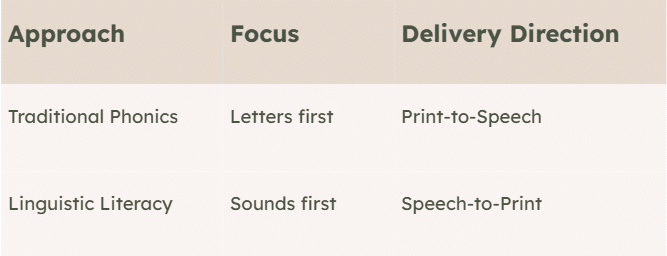
OG asks children to start with what they don’t know—the alphabetic symbols—and map back to what they do know.
Linguistic literacy starts with what they do know (spoken words) and maps forward into print.
In reading, direction matters.
And the brain consistently responds better to Speech-to-print.
Why we use Linguistic Literacy
After decades of OG-based instruction, I made the transition to EBLI because:
- Students progressed significantly faster
- They required less repetition and fewer rules
- Their confidence and independence soared
- They experienced reading as something logical—not laborious
- Parents saw measurable progress without years of remediation
- Effective for all students. Students with dyslexia, ADHD, or anxiety responded especially well
In my professional experience—and supported by modern cognitive science—linguistic literacy:
- is not just another method. It is a more effective, more efficient, and more brain-friendly pathway to reading success.
- It works with the brain, not against it.
- It builds readers, not memorizers.
- And it gets students where they need to go—faster, happier, and with far less frustration.
Closing thoughts for parents
You don’t have to choose between “good” and “bad” reading programs. Both OG and linguistic literacy have strengths. But . . .
. . . if your goal is the most effective, brain-aligned route to fluent reading, spelling, and writing, linguistic literacy stands out as the more powerful, intuitive approach.
Linguistic literacy, also known as linguistic phonics or Speech-to-Print, is a more intuitive, more efficient, and more neurologically aligned method of teaching reading.
OG paved the way. Linguistic literacy builds the bridge. EBLI gets your child across it — stronger, faster, and with a smile.