
This article serves as a companion to Handwriting Rewires the Brain and the Handwriting Assessment found on our Reading Assessment page. Below is a comprehensive exploration of the 18 specific areas transformed by consistent handwriting practice.
The Foundation: Cognitive Processing vs. Executive Functioning
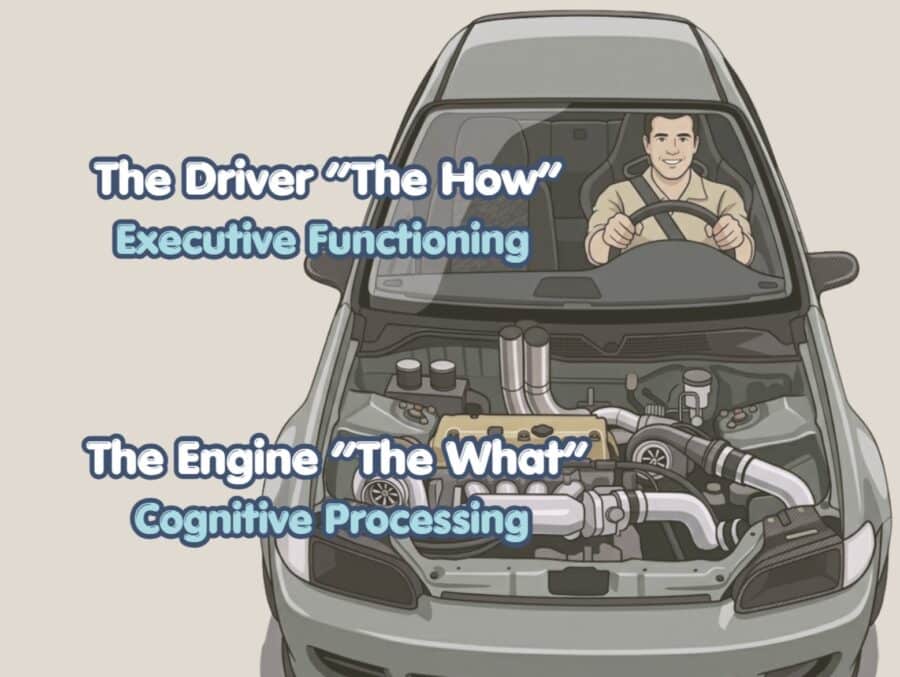
Handwriting is more than just “neat printing”—it is a sophisticated exercise that develops both cognitive processing and executive functioning. While related, they serve two distinct roles in the learning process.
The Breakdown
Feature | Cognitive Processing The “What” | Executive Functioning The “How” |
| Role | How the brain absorbs and retains info. | How the brain manages and directs itself. |
| Metaphor | The Engine | The Driver |
| Key Actions | Perceiving sounds/letters, storing memory, understanding language. | Paying attention, planning steps, self-monitoring (catching your own errors), controlling impulses. |
Both are whole-brain activities, but they utilize different networks. Executive functioning is managed by the prefrontal cortex (the command center). It bridges both hemispheres: the right side handles the big picture and emotional regulation, while the left manages sequencing and rules. Cognitive processing is also distributed across both hemispheres, but more specialized by task; the left hemisphere handles language, phonics, decoding, and logical sequencing, while the right handles pattern recognition, context, meaning, and the whole picture.
Handwriting is one of the few activities that forces these two sides to talk to each other simultaneously. The left brain handles language and sequencing; the right brain handles spatial awareness and pattern recognition. Keyboarding, by comparison, is a neurological shortcut that bypasses much of this vital cross-hemisphere engagement. This explains why handwriting is so neurologically rich compared to keyboarding
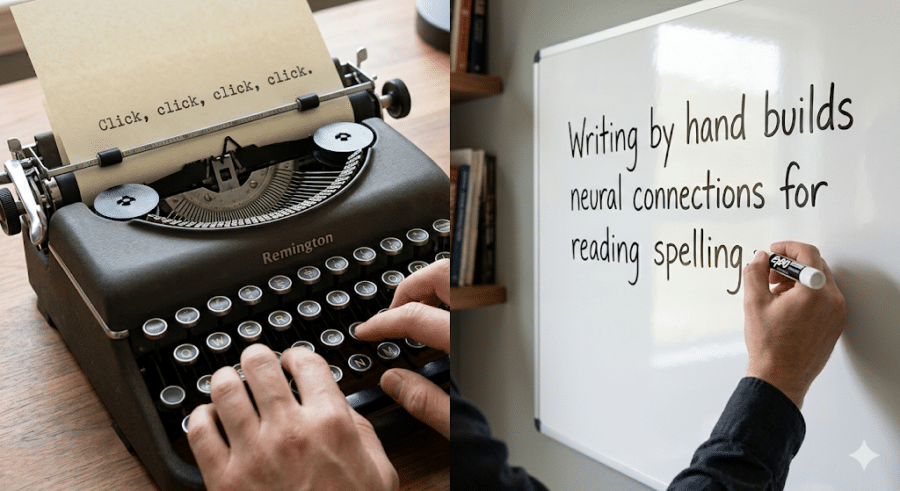
EBLI’s handwriting formula builds both cognitive processing and executive functioning simultaneously. The sequence is not arbitrary. Every step — a-z handwriting practice, metronome timing, teaching in a sound-to-letter direction, saying as you write, and dictation before copying — is deliberate because it builds a specific neural pathway.
The EBLI Difference: Sound-to-Letter
Traditional phonics programs move in a letter-to-sound direction, also known as print-to-speech, naming a letter and then recalling its sound . EBLI uses a Linguistic Literacy approach, which moves in the direction the brain naturally processes language: sound-to-letter. Because the brain processes spoken language first — we hear sounds before we see letters — moving in a sound-to-letter direction is more logical for the brain learning to read.
Since we hear sounds before we ever see letters, this reverse direction is more intuitive for a developing brain.
Comparing Approaches
- Traditional Phonics: name the letter, recall its sound, memorize the rule, drill the flashcards, and demonstrate mastery before moving on. This sequence disrupts the building of neural connections.
- EBLI (Sound-to-Letter): Identify the spoken sound, map it to a physical stroke, patterns instead of rules, spiral forward in complexity rather than stalling at mastery checkpoints, This sequence strengthens neural connections.
In traditional programs, letters are practiced by name — traced, copied, and drilled. In EBLI, we avoid tracing. Why? Because tracing actually hinders the development of automaticity in forming letters. Instead of internalizing the movement, the brain becomes dependent on the “track.” In contrast, our students practice the correct formation of letters freehand using simple phrases, The focus is on reinforcing a rhythmic fluid flow. Handwriting in EBLI is not a separate subject practiced in isolation. It is connected to sound from the very beginning in spelling and writing activities,
The 18 Benefits of Handwriting
1. Fluency
Handwriting builds automaticity. When the hand knows exactly how to form a “g” without thinking, cognitive resources are freed up for higher-level tasks like composing complex ideas.
2. Phonemic Awareness
“Say as you write” is a fundamental strategy used by EBLI to reinforce sound-letter connections. It helps students build a physical bridge between a sound and its symbol. This simultaneous action is the “secret sauce” for reading and spelling success, reinforcing the connection between sounds and their written symbols.
3. Thinking
Keyboarding is fast, but handwriting is deliberate. This naturally slower pace encourages deeper reflection and more organized thought patterns. .
4. Reading
Physical letter formation activates the brain’s reading circuits. If you can build the letter, your brain can decode the letter.
5. Attention
Managing stroke direction, spacing, and size requires sustained focus, which helps build a student’s overall “attention muscle,” building the capacity for sustained attention.
6. Sequencing
Forming letters requires following a specific sequence of strokes. Writing the letters in alphabetical order also directly practices sequencing skills. This constant practice of “step A then step B” reinforces general sequencing skills used in math and logic.
7. Motor Planning
The brain must plan a movement before the hand executes it. Handwriting develops motor planning ability and is a constant workout for the brain’s motor planning centers..
8. Motor Movement
Beyond the brain, the fine motor movements strengthen the small muscles of the hand and develop the precise motor control needed for many daily tasks
9. Expressive Language
Slowing down the writing process supports better word choice and more sophisticated sentence structures, enriching expressive language.
10. Receptive Language
Writing dictated words and sentences reinforces understanding of language structure, vocabulary, and meaning. Writing from dictation is king. It forces students to identify syllables and individual sounds in every word, reinforcing their understanding of language structure from the inside out. EBLI emphasizes dictation over copying because merely copying text does not require the student to think about what they are writing. In EBLI, copying text onto paper is only done after all corrections have been made: sentence structure, grammar, spelling, capitalization, punctuation, and word choice..
11. Learning
Research consistently shows that handwriting notes leads to better retention than typing. It requires the brain to process and paraphrase information rather than just transcribing it.
12. Memory
Handwriting is a multi-sensory “triple threat”: you see it, you hear it (as you say it), and you feel the movement. This encodes information far more deeply than a keystroke.
13. Phonics
Handwriting internalizes sound-letter patterns through repeated, active practice. In EBLI, alphabet handwriting practice is the only time letters of the alphabet are used. They are not used in reading or spelling because the brain processes language by matching sounds to letters — and letters rarely say their names. (e.g., W never says “double-u”). Handwriting links the symbol to the actual sound.
14. Vocabulary
The physical act of writing new words creates a stronger visual and motor memory of that word’s meaning and structure.
15. Comprehension
Writing about what has been read — by hand — requires the learner to mentally “digest” the information before it hits the page.
16. Spelling
Muscle memory is a powerful tool. Handwriting practice builds the muscle memory and visual memory of correct spelling patterns. Once the hand “remembers” a spelling pattern, accurate spelling becomes more automatic over time: a reflex rather than an effort.
17. Timing
When a student demonstrates proficiency in writing the letters of the alphabet in the correct order from a-z, in lower-case (because the majority of letters in words are lower-case), without verbal or physical cues, a metronome is introduced to build rhythm and timing. The goal is for the student to write a-z one beat per letter at 60 bpm (beats per minute). When that is achieved, a 1-minute timing is redone. The goal is 40 correctly formed lowercase letters in alphabetical order per minute (a-z + a-n).
Every letter of the alphabet is formed using a specific sequence of strokes, and in EBLI, students practice writing a-z repeatedly, in order, with the goal of building an even, steady rhythm. This repeated, rhythmic motor sequence develops a sense of timing and pacing; the hand learns not just “what” to write, but “when” and “how fluidly” to move.
The underlying connection parents may not realize: a child who struggles with rhythm and timing in handwriting often struggles with the same thing in sports, music, and daily tasks, because it is the same neurological system being taxed. Strengthening it through handwriting practice has a ripple effect. That ripple extends further than most people expect, touching coordination and sequencing in:
- Physical/Sports: catching a ball (timing the reach to meet the ball at exactly the right moment); swimming strokes ( arms and legs moving in a coordinated, rhythmic sequence); skipping, jumping rope ( the body must anticipate and respond to rhythm); riding a bike (pedalling in smooth, even cycles while steering)
- Music: playing an instrument (fingers must move in sequence at precisely the right moment); clapping or tapping to a beat ( internal timing guides the body)
- Daily Life: tying shoelaces (a prescribed sequence of steps executed with coordination); cutting food with a knife and fork (rhythmic, bilateral motor coordination); typing (fingers moving in sequence across a keyboard)
- Academic: math (executing multi-step problems in the correct order); reading aloud fluently (pacing words and breath together)
18. Rhythm
Handwriting has an inherent flow. Consistent spacing and stroke patterns support the development of rhythmic processing throughout the brain.
Note on Digital Tools
While we love technology, we do not use keyboards for EBLI tutoring sessions. All spelling and writing is performed on a whiteboard. This allows for immediate, “hands-on” corrective feedback and keeps the focus on building those vital neural connections.
How do you currently integrate the “say as you write” strategy into your daily literacy practice?