Low Comprehension Part 3: It’s not always about decoding
Low Comprehension Part 1: Why can’t my child understand what they read?
How EBLI’s diagnostic assessment reveals the hidden gap between reading fluency and reading comprehension, and what to do about it at any age.
Picture this . . .
Your child sits down with a book and reads aloud smoothly, confidently, without stumbling. Every word. Full sentences. Impressive pace. You feel relieved; they’re clearly a reader.
Then you ask: “So what was it about?”
Silence. A shrug. “I don’t know.”
If this sounds familiar, your child is not alone, and they are not lazy, distracted, or “just not a reader.” They are what literacy specialists sometimes call a word caller: a child whose fluency has outpaced their comprehension because the foundation underneath it has a crack that no one has found yet.
“Fluency without comprehension is not reading. It’s decoding on autopilot.”
This is exactly the problem that the EBLI (Evidence-Based Literacy Instruction) reading assessment is designed to find: and fix. By examining four interconnected skill areas, EBLI doesn’t just measure how a child reads. It reveals why comprehension is breaking down, even when everything looks fine on the surface.
What Is EBLI, and why does it assess four areas?
EBLI is a structured literacy approach grounded in the science of reading. Its diagnostic assessment evaluates:
- Phonemic awareness
- Reading
- Writing
- Spelling
These four areas are not assessed in isolation. They are examined together because each one illuminates a different facet of the same underlying skill: the ability to process the sounds, symbols, and structure of language automatically and accurately. When any one of them is weak, the others reveal it — and comprehension pays the price.
Breaking down the four assessment areas
Phonemic awareness: Can your child hear the sounds inside words?
Phonemic awareness is the ability to hear, identify, and manipulate the individual sounds, called phonemes, inside spoken words. It has nothing to do with letters yet. It’s purely about sound.
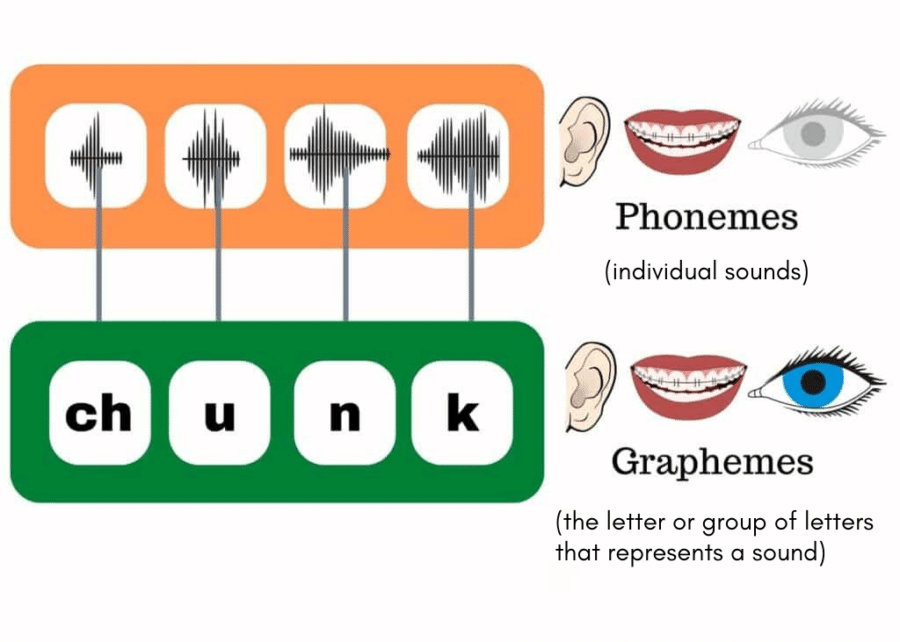
A child may appear to read fluently while having unresolved gaps in this area, particularly at more advanced levels: manipulating sounds inside multisyllabic words, deleting or substituting phonemes, or processing complex sound patterns quickly enough to keep up with meaning.
When phonemic awareness is shallow, a child’s reading is often more memorization than true decoding. They recognize words by shape, by first letter, by context, not by systematically processing every sound. That works for a while. Until it doesn’t.
Reading assessment: How is your child actually decoding?
The EBLI reading assessment doesn’t just measure whether a child gets words right. It examines how they get them right or wrong.
Specifically, it looks at:
- Whether the child processes every phoneme-grapheme correspondence, or guesses from partial information
- Whether they rely on context and word shape rather than full phonological decoding
- How they handle unfamiliar and multi-syllabic words, where compensatory strategies fail
This matters because fluent reading is not the same as accurate reading. A child who reads quickly by predicting from context is expending enormous cognitive effort to maintain the illusion of fluency. By the time they reach the end of a sentence, there’s almost nothing left in working memory to actually comprehend it.
Writing assessment: What does the page reveal?
When a child writes, they can’t rely on the visual shape of a word to help them; they have to encode sounds systematically from scratch. This makes writing tasks one of the most revealing diagnostic windows available.
A child who can read a word but cannot write it reliably often has shallow phonological knowledge: enough to recognize, not enough to produce. The EBLI writing assessment examines sentence construction, sound-symbol mapping, and whether phonemic knowledge is consistently internalized or merely surface-deep.
Spelling assessment: the most sensitive diagnostic signal
Of all four areas, spelling is the single most sensitive indicator of how deeply a child has truly internalized the structure of language.
Research consistently shows that strong spellers are strong comprehenders — not because spelling and comprehension are directly linked, but because both require the same thing: deep, automatic, and accurate phonological processing. Spelling errors in a “fluent” reader are like cracks in a wall: small on the surface, but they tell you exactly where the structure underneath is unstable.
The EBLI spelling assessment maps those cracks precisely, giving educators and parents a clear picture of which phoneme-grapheme correspondences are truly mastered and which are being patched over.
Why Grade 3 Is the critical moment to act
Grade 3 is not just another year of school. It is the year the entire nature of reading changes.
In Grades K–2, children are learning to read. In Grade 3 and beyond, they are reading to learn. Texts become longer, denser, and more conceptually demanding. Vocabulary jumps. Background knowledge gaps become visible. And the strategies that masked a reading gap in early elementary school — guessing from pictures, leaning on familiar vocabulary, using context — start to break down rapidly.
The gap between fluency and comprehension that looks manageable at Grade 3 can become a chasm by Grade 6.
The EBLI assessment at this stage doesn’t just diagnose a problem. It catches it at the last moment when intervention is still straightforward, before the academic consequences compound and before the child has spent years building an identity around being “bad at reading.”
What the assessment can identify at Grade 3:
- Phonemic awareness deficits at the manipulation level, even when blending and segmentation seem adequate
- Decoding based on first-letter-plus-context guessing rather than full phonological processing
- Spelling errors that reveal shallow sound-symbol knowledge on phonetically regular words
- Writing that exposes inconsistent or incomplete phoneme-grapheme mapping
Each of these findings directly informs a targeted intervention plan, not generic comprehension strategies, but precisely calibrated structured literacy instruction at exactly the level the child needs.
What about older students? Does this still apply?
Yes, and in some ways, even more urgently.
The fluent-but-low-comprehension profile does not typically resolve on its own with time and can persist even into adulthood without intervention.
Key insights for parents:
- It doesn’t resolve on its own: The struggle to truly understand what they read isn’t a problem that children naturally grow out of. Without targeted support, it can continue to impact middle schoolers, high schoolers, and even adults.
- The root cause can remain hidden: Students can go for years carrying undetected gaps in their basic reading building blocks (like phonics). These core skill gaps are not about intelligence, but about missed fundamental reading mechanics that went unnoticed.
- They develop clever ‘tricks’ to get by: As they grow older, students with this profile become incredibly smart at creating strategies to memorize words, use context clues, and mask their true difficulties. While this helps them get by in the short term, it ultimately prevents deep comprehension and can make the underlying problem very difficult for both parents and teachers to spot.
Understanding this profile is empowering. It shows that the issue is not about a lack of effort or ability, but rather specific, undetected skill gaps that can be addressed to unlock true reading comprehension.
The EBLI assessment is just as diagnostically relevant for a Grade 8 student as it is for a Grade 3 child. The four areas assessed are the same. What changes is the context around the assessment:
- Harder to detect, harder to shift. Compensatory habits are more entrenched.
- Low comprehension is already affecting performance across every subject, not just reading class. Academic stakes are higher.
- The same phonological weakness that “worked” at Grade 3 is now actively disabling at Grade 7 or 8, where abstract vocabulary and complex sentence structure dominate every subject. Text complexity has outpaced the gap.
- An older student who has always been seen as a capable reader, by teachers, by parents, and by themselves, may find it difficult to accept that something foundational has been missed. Sensitive, empowering framing of the assessment matters enormously. Self-image is involved.
- Remediation for older students needs to use age-appropriate materials — no Grade 3 readers for a Grade 8 student. It also typically addresses word structure and academic vocabulary alongside the foundational sound skills. Phonics is not learned in isolation but in the context of whole words and sentences. Intervention looks different, and that’s by design. Intervention looks different.
The answer to what is wrong may be exactly the same at age 14 as it was at age 8. The answer to how long it takes to address — and how much has already been lost in the meantime — is very different.
This is not a reason to give up on older readers. It is a reason to assess them accurately and intervene deliberately. The EBLI diagnostic framework gives educators and specialists the tools to do exactly that.
The bottom line
If your child reads every word on the page but can’t tell you what they’ve read — at any age — the answer is not more reading practice. It is a precise, evidence-based diagnostic assessment that looks beneath the fluency to find out what is actually happening.
EBLI’s four-area assessment does that. It identifies exactly where phonological processing breaks down, gives educators actionable data to design targeted instruction, and — most importantly — gives children and students a clear explanation for why reading has always felt harder than it looked from the outside.
Fluency is not comprehension. But with the right diagnosis, it can become the foundation for it.
Want to learn more?
Request an EBLI diagnostic assessment. The earlier the assessment, the sooner the right support begins — but it is never too late to find out what is really going on.