
The science behind EBLI, the evidence-based literacy program we use at Brilliant Futures Tutoring
If your child has been struggling to read, or if you’ve simply noticed that homework time feels harder than it should, you’re not alone. Many families find themselves searching for answers. What they often discover is that the way reading is taught matters enormously.
At Brilliant Futures Tutoring, we use a program called EBLI (Evidence-Based Literacy Instruction). It’s built on decades of research into how the brain actually learns to read. And the results speak for themselves.
This post walks you through what makes EBLI different, why it works, and what you can expect when your child learns to read this way.
A quick word about how reading is taught
Most of us learned to read by being shown the alphabet, sounding out letters one by one, and memorizing a long list of rules, followed by a longer list of exceptions to those rules. If that feels a bit backwards, that’s because, in many ways, it is.
Reading instruction has historically started with print, with letters on a page, and worked backward toward sound. This is called print-to-speech. It asks children to decode symbols they’ve never seen before, using rules that only sometimes apply, and then somehow make meaning out of the result.
There is a better way.
What is linguistic literacy (speech-to-print)?
Linguistic literacy, also called the speech-to-print or linguistic phonics approach, flips the traditional reading process. Rather than starting with letters on a page and working toward sound, it starts with spoken language, which children already know, and teaches them how those sounds are represented in print.
Here’s the key difference: sounds and their spellings are always taught in the context of whole, meaningful words, never in isolation. Traditional instruction might introduce the letter “b” by saying “b says /b/:” a fragment with no context and no meaning. Speech-to-print instead asks: what sounds do you hear in the word “mat”? From there, children connect each sound to the letter or letters that represent it. The whole word, something real and familiar, is always the starting point.
This approach makes sense when you consider what children already know when they arrive at school. By the time most children start school, they have a spoken vocabulary of thousands of words and can hold full conversations. They are already fluent users of language. Speech-to-print builds on that remarkable foundation, rather than setting it aside in favour of abstract letter drills.
Since letters were invented to represent sounds, not the other way around, teaching from sound to print is simply following the logic of how written language works. Reading becomes a natural extension of something your child already does brilliantly: communicate.
With that foundation in place, let’s look at what EBLI does specifically, and why each element makes such a difference.
Element 1: Sounds first, letters second
In EBLI, lessons begin with whole spoken words. Children listen carefully to identify the individual sounds they hear, then learn which letters or combinations of letters represent each of those sounds. This sequence is called sound-to-symbol mapping, and it follows the natural direction in which language works.

Teaching
Snapshot
- “What’s the first sound you hear in ‘fast’?” → /f/ → children say as they write /f/ (sound/not letter name)
- ”What’s the next sound?” → /a/ → they say as they write /a/
- ”Next?” → /s/ → /s/
- ”And the last sound?” → /t/ → ‘t’
- Then they say all the sounds together, blend them, and read the word.
This approach also means that reading and spelling are taught together from the very beginning, not as separate subjects, but as two sides of the same coin. When a child knows how to hear a word’s sounds and connect them to letters, both reading and spelling improve at the same time.
It also eliminates a surprisingly common source of confusion: letter names. In early reading instruction, letter names can actually get in the way, because letters don’t “talk;” they make sounds. EBLI focuses on those sounds from day one.
In EBLI, students never use letter names when learning to read, spell, or write — because letters don’t talk. They make sounds!
Element 2: Patterns, not rules
Here’s something most parents don’t know: English spelling rules have an average exception rate of around 50%. Teaching a child to rely on rules that only sometimes work is a recipe for confusion and frustration.
EBLI takes a fundamentally different approach. Instead of memorizing rules, children learn to recognize patterns, and this works beautifully, because it’s exactly what the human brain is designed to do.
Our Brains Are Natural Pattern-Seekers
Long before your child stepped into a classroom, their brain was busy detecting patterns in language, the rhythm of sentences, the way words rhyme, the sounds that tend to come before certain other sounds. This is called association learning, and it happens automatically, often without conscious effort.
EBLI taps directly into this strength. Rather than asking children to memorize a rule and then remember when to apply it, the program exposes them to real patterns across real words, allowing the brain to do what it does best.
Our brains are wired to seek patterns; they radiate with pattern-seeking energy, giving us the ability to make quick associations.
What Patterns Look Like in Practice
Children learn, for example, that:
- The long /ee/ sound can be spelled several ways: ‘e’ as in he, ‘ea’ as in dream, ‘ie’ as in cookie, ‘ee’ as in see, ‘y’ as in happy, ‘i’ as in trio and more.
- The spelling <ea> doesn’t always make the same sound; it’s /ē/ in eat, /ĕ/ in head, and /ā/ in steak.
- A single sound might be written with just one letter, or with two, three, or even four letters working together.
Rather than being confused by this, children who learn through EBLI become flexible and confident. They develop what researchers call “set for variability,” the ability to try different sound pronunciations until a word makes sense. This is exactly what skilled adult readers do, often without realizing it.
Element 3: Cognitive flexibility
Skilled readers don’t sound out every word perfectly on the first try. When they encounter an unfamiliar word, they make an attempt, check whether it sounds like a real word they know, and adjust if it doesn’t. This process happens in a fraction of a second, and most fluent readers do it without even noticing.
This is cognitive flexibility, and it is a skill that can and must be taught. EBLI builds it in from the very beginning.
What this looks like in a lesson
In EBLI, students learn to “flex” sounds. If a first attempt at a word doesn’t produce something recognizable, they are taught to try a different pronunciation for one or more of the letters, rather than guessing from context or giving up. This is sometimes called “set for variability” in the research literature.
Teaching
Snapshot
A student encounters the word “elephant” for the first time and reads “ee-lee-fant.” They immediately recognize it isn’t a real word. Having been taught that the same spelling can represent different sounds, they try again, adjusting the sounds until the word clicks. After a couple of attempts, they read it correctly.
That moment of self-correction is not accidental. It is a direct result of instruction that builds cognitive flexibility alongside phonics, rather than treating them as separate skills.
This flexibility also removes one of the most common sources of reading anxiety: the fear of being wrong. When children know they have a strategy for unfamiliar words, reading becomes a problem to solve rather than a test to pass.
Element 4: Multiple skills taught together
Traditional reading instruction tends to teach skills in separate blocks: phonemic awareness here, phonics there, spelling on another day, writing in a separate session altogether. The problem is that reading doesn’t work in silos. All of these skills are deeply interconnected, and separating them makes each one harder to learn.
EBLI integrates 4-7 core reading skills into every lesson:
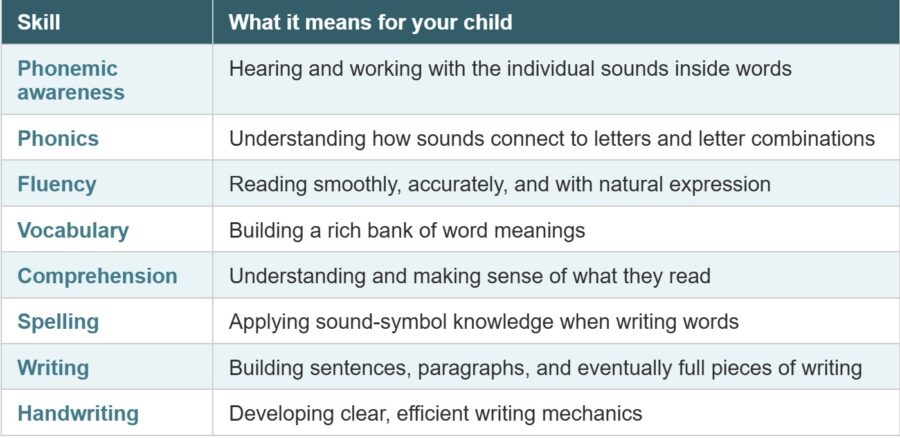
Because multiple skills are practised together in every lesson, rather than in isolation, children develop a more natural, connected relationship with reading and writing. Learning feels cohesive rather than fragmented, and skills reinforce each other in real time.
Element 5: Reduced cognitive load
Learning to read is genuinely hard work for a young brain. Every bit of unnecessary mental effort, every rule to remember, every skill practiced separately, with no clear connection to the bigger picture adds to what researchers call cognitive load: the strain placed on working memory during learning. When cognitive load is too high, learning slows down or breaks down entirely.
EBLI is designed at every level to reduce that strain. Three elements work together to make this possible.
- Starting with sound
Because EBLI begins with the spoken word rather than the printed letter, children are working from something they already know fluently. There are no arbitrary letter names to hold in memory, no rules to retrieve before a sound can be attempted. The starting point is always familiar, which frees up mental energy for the new learning: connecting sounds to their spellings.
- Patterns instead of rules
Rules require conscious retrieval. Every time a child needs to apply a spelling or syllable rule, they must pause, locate the rule in memory, check whether it applies, and then act on it. Patterns, by contrast, are absorbed gradually and recognized automatically. A child who has encountered the /ee/ pattern across dozens of real words doesn’t need to think about it: they simply recognize it. This is a fundamentally lighter cognitive process, and it is one of the key reasons EBLI produces faster results.
- Integrated skills
When phonics, spelling, reading, and writing are practiced as one connected activity rather than four separate ones, the brain is not constantly switching contexts. Each skill reinforces the others, which means less total effort is required to build all of them. The result is that children make faster progress with less frustration, because their mental energy is being used efficiently rather than being divided and redirected.
Element 6: Explicit instruction
Reading is not a natural process. Unlike spoken language, which children acquire simply through exposure and interaction, written language must be taught clearly, systematically, and deliberately. This is true of both the Orton-Gillingham approach and EBLI: both share a commitment to explicit, structured instruction where nothing is left to chance or discovery.
The significant difference is not whether instruction is explicit. It is the direction of that instruction.
Two approaches, one key difference
Orton-Gillingham begins with print and works toward sound: letters and letter patterns are introduced first, and students learn to connect them to spoken sounds.
By “patterns” here, we mean the specific letter combinations that OG introduces as printed units: consonant digraphs like ch, sh, th, ck, blends like -tch, phonograms like -ang, -ing, -ong, vowel teams like ai and ay, and rule-based groupings like words ending in ff, ll, ss. Each is presented visually first; the student sees the letters, then learns what sound or sounds that combination makes.
This is worth noting because EBLI also teaches patterns but arrives at them from the opposite direction. In EBLI, the sound comes first. A student hears the /ch/ sound in a whole word, identifies it, and then discovers that this sound is written as <ch>. The pattern is the destination, not the starting point. Same patterns, opposite direction of travel, and that difference in direction is at the heart of why speech-to-print produces faster, more intuitive results.
EBLI begins with sound and works toward print: spoken words are the starting point, and students learn to connect the sounds they already know to their written representations.
Both approaches are rigorous and structured. But the direction matters enormously. When instruction moves from the known to the unknown, from speech to print, from the familiar to the new, learning is faster, more intuitive, and more durable. Children are not learning an abstract system from scratch. They are mapping a new layer of knowledge onto a language foundation they have already spent years building.
What explicit instruction looks like in EBLI
In EBLI lessons, students learn to:
- Isolate and blend the individual sounds in words
- Recognize that the same sound can be spelled in more than one way
- Recognise that the same spelling can represent more than one sound
- Apply a reliable strategy for reading and writing multisyllable words
- Compose sentences and paragraphs with increasing confidence
Nothing is assumed, guessed at, or left implicit. But because the direction of instruction follows the natural logic of language, explicit teaching in EBLI feels less like drilling and more like discovery.
Element 7: Immediate corrective feedback
When your child makes a mistake in an EBLI lesson, it isn’t glossed over or saved for later. It’s addressed right away, kindly and clearly, so that the correct version is what the brain stores.
This matters more than it might seem. Memory is formed around the most recent version of an experience. If a child reads a word incorrectly and moves on, the incorrect version can become the stored version. Correcting errors in real time prevents this from happening.
Why this is so important
EBLI instructors do not encourage “inventive spelling” — the practice of letting children write words however they sound to them.
While it may seem creative or confidence-building in the short term, inventive spelling can cement incorrect patterns in memory that then need to be unlearned. EBLI’s approach ensures that what goes in is accurate from the start.
Immediate feedback also makes every moment of instruction count. Rather than spending weeks practising one skill before moving on, children are continuously refined and supported, which accelerates progress significantly.
Element 8: Spaced and spiraled learning for cumulative growth
One of the most well-supported findings in learning science is that spacing out practice over time leads to far better retention than massed practice in one sitting. This is sometimes called the “spacing effect,” and it’s a cornerstone of how EBLI is structured.
The goal of this approach is cumulative growth: not simply moving through a sequence of skills, but building a body of knowledge where everything learned continues to support everything that comes after. Skills compound rather than fade.
Spaced learning
Rather than drilling a skill until it’s mastered before moving to the next level, EBLI revisits material at increasing intervals. This creates a productive form of effortful recall. Your child’s brain has to work slightly harder to retrieve something learned a few days ago, and that extra effort is what strengthens the memory. The result is retention that holds, not just performance that looks good in the moment.
Spiraled learning
As children progress, earlier concepts come back, but at a slightly deeper or more complex level. A spelling pattern introduced early on reappears later in a new context, allowing your child to build on what they know rather than starting from scratch each time. Every return visit adds a new layer to an already solid foundation.

What this looks like at home
You might notice that your child keeps revisiting concepts you thought they’d already finished. This is intentional and research-backed. The goal isn’t to move through topics as quickly as possible: it’s to build knowledge that actually sticks. Think of it as building a brick wall, not stacking cards. Every brick laid early strengthens everything built on top of it.
Element 9: Intuitive learning
One of the most powerful outcomes of speech-to-print instruction is something that happens quietly in the background: children begin to absorb patterns without being explicitly taught every one of them. Over time, the brain notices which sounds, letters, and word parts tend to go together, and begins to recognise and apply them automatically. This is intuitive learning, and it is one of the reasons EBLI produces results that go well beyond what was directly taught in any single lesson.
From deliberate to automatic
In the early stages of reading instruction, decoding requires conscious effort. A child thinks through each sound deliberately. Over time, with meaningful exposure to patterns across real words, that effort fades. Recognition becomes automatic. The child no longer has to think about the <igh> pattern in ‘night’ and ‘light.’ They simply see it and know it. This shift from deliberate processing to automatic recognition is what fluency is built on.
Why broad exposure matters
Intuitive learning requires exposure to a wide range of patterns, not just the simplest ones introduced one at a time over many months. When students encounter multiple spellings for the same sound within a single lesson, the brain has more data to work with and begins making connections sooner. Limiting students to narrow, tightly controlled input, as many traditional programs do, actually slows the development of intuitive reading by starving the brain of the variety it needs to detect patterns.
Connected, meaningful learning
Intuitive learning thrives when skills are taught in connection with each other and with real language, not in isolated drills. Reading stories, writing for a purpose, spelling words from conversation, discussing words in context, these activities give the brain the rich, varied input it needs to build the kind of deep pattern knowledge that makes reading feel natural and effortless.
Element 10: Eyes on print
One of the most practical strategies in EBLI is also one of the most underrated: keeping your child’s eyes on the actual words as they read.
It sounds simple, but it has a profound effect. When children follow text while reading or listening, their brain is simultaneously processing the visual spelling patterns, the sounds of the words, the rhythm of the sentences, and the meaning of the story. This multi-layered exposure builds fluency and vocabulary far faster than isolated practice.
The audiobook advantage
EBLI enthusiastically supports the use of audiobooks paired with printed text. When a child follows along with an audiobook, they experience books at their natural grade level, not limited to the simpler texts their independent decoding level might allow. They hear fluent, expressive reading while their eyes track the words, building vocabulary, comprehension, and love of reading all at once.
Try this at home
Find an audiobook version of a book your child is interested in. Sit with them and have them follow along with the print copy while the audio plays. Even 15 minutes a few times a week makes a measurable difference in vocabulary, fluency, and reading stamina. The key: eyes on the words.
Element 11: Fast, interactive lessons
A child who is bored or anxious is not a child who is learning effectively. EBLI lessons are designed to feel less like drills and more like conversations: fast-moving, engaging, and low-stress.
One key tool: whiteboards
Writing on a whiteboard and erasing without any trace removes the fear of mistakes. There’s no pressure to be perfect, no evidence left behind of what went wrong. This creates an environment where children are willing to try, which is exactly the right condition for learning.
Lessons are also cumulative rather than compartmentalised. A child doesn’t sit through 20 minutes of phonics followed by a separate 20 minutes of spelling. Instead, multiple reading skills are woven into every activity, which keeps the pace brisk and the engagement high.
The bigger picture: why all of this works together
Each element of EBLI is powerful on its own. But the real magic is in how they work together.
- When a child learns sounds first (Element 1)
- recognizes flexible patterns instead of rigid rules (Element 2)
- develops the flexibility to adjust sounds until a word makes sense (Element 3)
- practices multiple skills simultaneously (Element 4)
- benefits from reduced strain on working memory (Element 5)
- receives clear, systematic, direction-appropriate instruction (Element 6)
- receives immediate and accurate feedback (Element 7)
- revisits learning over time for cumulative growth (Element 8)
- absorbs patterns intuitively through meaningful exposure (Element 9)
- keeps eyes on print across rich, connected text (Element 10)
- and does all of this in a fast, supportive environment (Element 11)
— something remarkable becomes possible
The result! Element 12: early use of authentic text
When all eleven elements are in place, something becomes possible that many families have been told to simply wait for: their child reading real books, real stories, and real language, not carefully controlled word lists or artificially simplified texts.
In some structured literacy programs, patterns are introduced so gradually, and so narrowly, that students may spend months working only with word lists before encountering a real sentence. By the end of some program levels, a student may have been taught only a small fraction of the sound-spelling patterns they need for genuine reading. The effect is that authentic text remains out of reach for far longer than necessary, and the patterns that would make reading click, patterns that appear naturally and abundantly in real books, stay hidden.
EBLI takes a different path. Because students learn to recognise patterns flexibly from the start, because their cognitive load is managed so that each lesson builds on the last, because intuitive learning is happening in the background from day one, children are ready for authentic text far sooner. They don’t need every pattern to be formally introduced before they can encounter it in a real book. Their brains are already primed to notice, absorb, and use it.
Early access to authentic text is not simply a reward for progress. It is a driver of progress.
Real books expose children to the full richness of written language: varied vocabulary, natural sentence rhythms, and the full range of spelling patterns working together in context. This is the environment in which intuitive learning flourishes, in which fluency builds naturally, and in which children begin to experience reading not as a skill to be practised but as something genuinely worth doing.
That shift — from reading as a task to reading as an experience — is what EBLI is designed to make possible, and to make possible sooner than most families expect.
The research behind it
EBLI is not a trend or a philosophy. It’s evidence-based instruction grounded in decades of reading science. The fields of linguistics, cognitive psychology, and neuroscience all point to the same conclusion: the brain learns to read best when instruction starts with sound, builds through patterns, and connects all literacy skills in meaningful, contextual ways.
This is exactly what EBLI does.
And it’s why the families who come to Brilliant Futures Tutoring consistently see their children not just reading better, but feeling better about reading.
What you can do now
You don’t have to wait for a tutoring session to make a difference. Here are a few simple things that align with EBLI principles and can be done at home today:
- When your child is trying to spell a word, encourage them to say it slowly and listen for each sound, rather than reaching for a rule or guessing.
- If you have a whiteboard at home, use it. Low-stakes practice beats worksheets every time.
- Pair audiobooks with print and sit with your child while they follow along.
- Point out spelling patterns rather than exceptions: “Look: ‘night’ and ‘light’ end the same way. What do you notice?”
- Keep reading joyful. The more your child encounters language in positive, meaningful ways, the faster their brain builds the connections that make reading automatic.
Your child deserves to love reading. EBLI gives them the foundation to do exactly that.