
Faster reading skill development for any child
See results much sooner than any other method
Our approach: a smarter way to learn to read and spell
Faster reading skill development for any child —
see results much sooner than any other method
“Making Reading a Reality”
The reading crisis
- 40% of students across the nation cannot read at a basic level.
- Nearly 70% of low-income fourth grade students cannot read at a basic level.
Understanding how your child learns to read is crucial in choosing the right approach for their success. Many parents encounter common reading myths that can delay progress:
- Reading develops naturally, like speaking — children will simply “pick it up” through exposure.
- Phonics isn’t necessary (research shows it’s crucial for struggling readers).
- Strong oral language skills will lead to reading proficiency.
- Children will eventually catch up on their own. The fact is that without intervention, they often fall further behind.
- Reading speed equates to reading skill.
- Children should guess words from pictures, first letters, and context.
View this list of common reading myths and misconceptions and find out more.
Reading must be taught
Reading is a man-made invention. It is a skill that requires explicit instruction in phonemic awareness, phonics, and decoding; it does not develop naturally.
Why many reading methods fall short
Many traditional reading methods struggle to meet the needs of all children. Here’s why:
1. Print-first approaches
Most traditional methods begin by teaching letter names and print-based rules before focusing on sounds. This can overwhelm children — particularly those with dyslexia, ADHD, or other learning challenges — and emphasizes memorization over understanding.
2. Guessing and three-cueing
Methods like three-cueing encourage children to guess words from context, pictures, or partial visual clues instead of decoding accurately. These strategies don’t develop strong decoding skills and fail when more complex text and vocabulary appear and visual cues are absent in Grade 3-4 onward.
3. Phonics rules overload
Many traditional phonics programs focus on teaching overly complex rules (e.g., syllable types, phonics rules, blends) and exceptions, which can overwhelm and confuse students, especially those who struggle to memorize or apply them.
4. Isolated skill learning
Teaching reading skills — phonemic awareness, phonics, spelling, handwriting, writing, vocabulary, comprehension, and handwriting — in isolation is inefficient and causes a disconnect. Children may learn to sound out words but struggle to apply the skill in meaningful contexts. Teaching skills in isolation is both inefficient and demeaning to students’ intellect.
5. Lack of focus on phonemic awareness
Phonemic awareness — the ability to hear and manipulate sounds in words — is a critical early reading skill. Many methods emphasize letter recognition over sound awareness, leaving gaps in decoding ability, especially for struggling readers.
Why 40% of children have reading issues:
- Inconsistent Instruction: Many schools use a mix of methods (balanced literacy, phonics, whole language), leading to inconsistent instruction.
- Limited Early Intervention: Struggling readers often don’t receive targeted, explicit instruction early enough, causing them to fall further behind.
- Over-Reliance on Memorization: Programs that emphasize memorization of sight words and rules without teaching decoding strategies leave students unprepared for more complex reading
Linguistic Literacy (speech-to-print): a better and faster method
Linguistic Literacy, also known as speech-to-print, is an approach to teaching reading that begins with spoken language (sounds) and maps those sounds to their corresponding written symbols (letters and letter combinations).
This method contrasts with the traditional print-to-speech approach, which typically starts with letter names and print concepts before sounds.
How Speech-to-Print works
Phonemic awareness first: Children are taught to hear and manipulate sounds (phonemes) in words, building a critical foundation for reading.
Sound to symbol mapping: Children learn how to map each sound in whole words to their specific letter or letter combination; letters and sounds are never taught in isolation, for example b says /b/, d says /d/. Also, letter names are avoided because they can cause confusion; they are labels invented by man that rarely reflect a letter’s sound — for example, the letter d never says /dee/, t never says /tee/, and w never says /double-u/.
Practical Application: Spelling first. Students learn to break whole words into their individual sounds and match each sound to its written symbol. Decoding (reading) is the other side of the coin: students blend the sounds represented by the symbols to read words. There is no word memorization or reciting of letter names followed by attempts to blend them.
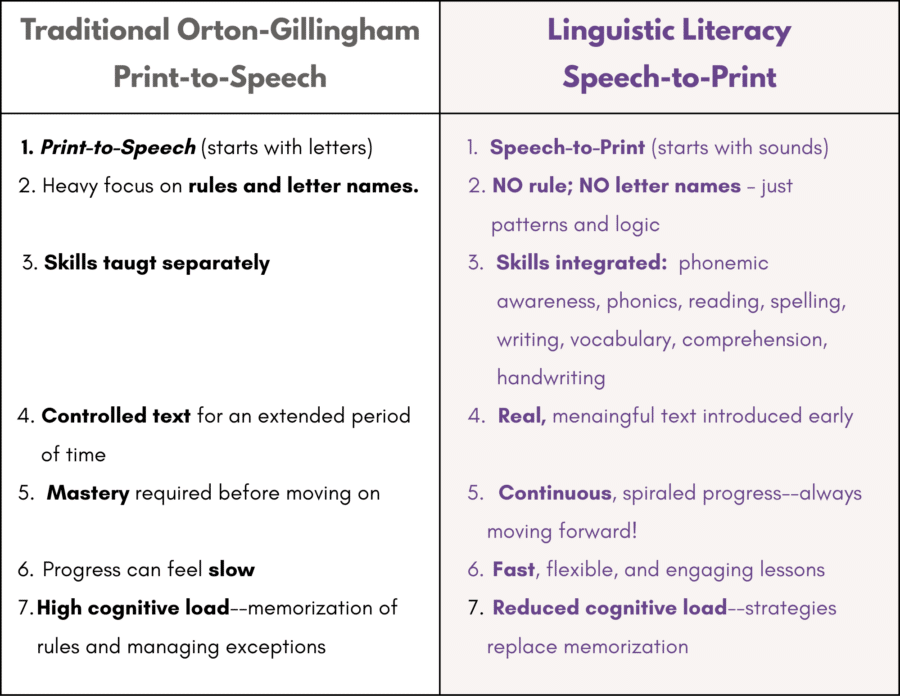
Traditional approaches teach children from a print-first perspective — introducing alphabet letter names first and/or matching letters to sounds in isolation (for example, b says /b/; ea says /ee/, /e/, or /ay/ as in see, head, or great; or eigh as in eight) — and are often heavily rule-based.
In contrast, Linguistic Literacy uses:
- NO rules
- NO sounds or letters in isolation
- NO memorization
- NO spelling tests
- NO flashcard drills
Why Speech-to-Print is so effective
Aligns with how the brain naturally processes language:
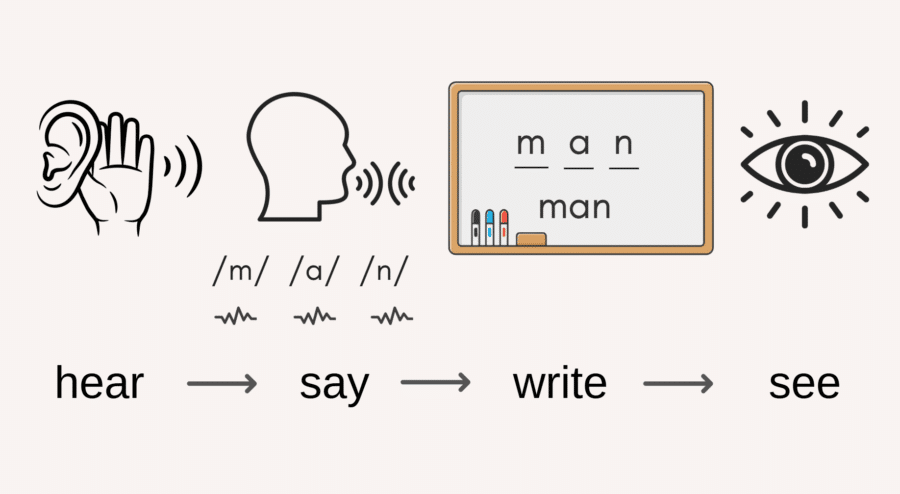
Stronger phonemic awareness: Research shows phonemic awareness is one of the most important skills for early reading success.
Reduces cognitive overload: Focusing on sounds first simplifies learning and reduces the burden of memorizing spelling rules or letter names upfront.
Helps all learners — including dyslexic learners: The approach aligns closely with how the brain processes spoken language and reduces reliance on visual memorization.
The difference
“The definition of genius is taking the complex and making it simple — Albert Einstein
That’s exactly what Linguistic Literacy does — it takes something complex and makes it simple, intuitive, and lasting!
Unlike traditional phonics programs that rely on memorizing letter names and rules (and their many exceptions), Linguistic Literacy focuses on sounds first. Students learn to hear, analyze, and connect the sounds in spoken words to the letters that represent them — helping them decode and spell any word, even those they’ve never seen before.
Traditional Oton-Gillingham vs. Linguistic Literacy
Introducing EBLI Linguistic Literacy program
“The EBLI system provides students and teachers with consistent strategies instead of inconsistent rules.” — Nora Chahbazi, EBLI Founder
EBLI (Evidence-based Literacy Instruction) is an innovative and systematic approach designed to teach reading, spelling, and writing using the Linguistic Literacy, speech-to-print method.
Unlike traditional phonics programs that often emphasize letter names or rely on rules-based instruction, EBLI focuses on connecting spoken sounds in whole words with their corresponding written symbols.
How EBLI works
- Sound-Based Learning: EBLI teaches reading by focusing on phonemic awareness (the ability to hear and manipulate sounds in words) and linking those sounds directly to print, making decoding more intuitive, particularly for struggling readers or those with dyslexia.
- Integrated Skills: Rather than teaching reading skills in isolation, EBLI integrates 5-8 skills into each activity: phonemic awareness, phonics, reading, spelling, writing, vocabulary, comprehension, and handwriting. This interweaving of skills builds a more solid foundation for understanding
- Whiteboard work: Instead of pencil and paper, students develop their skills using whiteboards. This confidence-boosting approach reduces the anxiety associated with mistakes, since a marker wipes away cleanly and effortlessly — no erasing, no trace left behind.
- Error Correction and Immediate Feedback: EBLI emphasizes immediate error correction so students don’t develop bad habits, especially effective in 1-on-1 tutoring.
- Accelerated Progress: By teaching multiple literacy components simultaneously and focusing on practical application, EBLI helps students make rapid gains. Many students progress multiple grade levels in a relatively short time frame.
EBLI’s four-fold focus
EBLI is built on four simple but powerful principles:
- Letters spell sounds
- /l/ = l /b/ =b /m/=m
- Sounds can be represented by one to four letters
- cat → /c/ /a/ /t/
- dish → /d/ /i/ /sh/
- weight → /w/ /eigh/ /t/
- though → /th/ /ough/
- Sounds can be spelled in multiple ways
- Example — the /ee/ sound:
- He dreams of cookies and sees a happy trio.
- Spellings can have multiple sounds
- example: OW in cow and low; OU in cloud, pour, wound, young
How EBLI differs from traditional phonics
Here’s what makes EBLI instruction unique.
- Speech-to-print, not print-to-speech: Students connect sounds in whole words to letters — a natural process since letters were invented to represent sounds.
- No letter names for early reading/writing: Avoiding letter names prevents confusion for beginning readers.
- Patterns, not rules: Students learn to recognize and apply patterns, tapping into the brain’s natural pattern-seeking ability.
- Fast, interactive lessons: Streamlined instruction keeps engagement high and accelerates progress.
- Early use of authentic text: Students quickly move beyond controlled text to real reading material.
- Cumulative growth instead of waiting for mastery: Students continue progressing while earlier skills are reinforced through spiraled review.
- Cognitive flexibility: Students learn to “flex” sounds until the word makes sense — just like skilled readers do.
- Reduced cognitive load: Multiple skills — phonemic awareness, phonics, spelling, reading, writing, comprehension, and vocabulary — are integrated within each activity, rather than taught in isolation.
Fast results: what this looks like in practice
Since integrating EBLI with students from Kindergarten through Grade 12, the results have been remarkable:
- Accelerated progress — students read authentic text much sooner.
- Reduced cognitive load — less memorization, more meaning.
- Increased confidence — students take ownership of their learning.
- Greater engagement — less repetition, more relevance.
Most importantly, students begin to see themselves as readers. That shift — from “I can’t” to “I can” — changes everything.
We use EBLI for all our students and have found it to be the fastest and most effective program available. It works for all reading levels — for children and adults, and for children with dyslexia.
Traditional spelling instruction often emphasizes memorizing word lists for weekly tests. Unfortunately, most of those spellings are quickly forgotten. EBLI changes that by teaching students to analyze words by sound — the way the brain naturally processes language.
For example:
- ship → /sh/ /i/ /p/
- special → /s/ /p/ /e/ /ci/ /al/
Supporting Learning at Home
You can reinforce EBLI strategies at home in a few simple ways:
- Watch the short introduction videos: About EBLI and How EBLI Works.
- Try the EBLI Reading Adventures Apps (available for iPad and Android).
- Encourage “Say the sounds” when reading or spelling new words — the simplest, most powerful support you can provide.
A final word
Many families come to me asking for Orton-Gillingham instruction because they’ve heard it’s the “gold standard.” While OG certainly has value, Linguistic Literacy goes further — simplifying reading, accelerating results, and reigniting joy in learning.
If your child could feel confident and excited about reading in weeks instead of years, how would that change things at home and school?
Let’s find out — together
Ready to see your child thrive?
Schedule a complimentary consultation to learn how Brilliant Futures Tutoring can help your child become a confident, capable reader.
Contact Us Today
Laurel Sanders, Reading Specialist
Brilliant Futures Tutoring
“Making Reading a Reality.”