
A simple habit that builds reading fluency and confidence.
Why strong pencil skills build strong readers
In our digital world, handwriting can look like a forgotten skill. Kids type on tablets, click on Chromebooks, and swipe through apps. Handwriting practice? That can feel old-fashioned.
But here is what research, neuroscience, and years of literacy instruction experience tell us:
Handwriting isn’t just about neat letters; it is a powerful driver of reading fluency and brain development.
At Brilliant Futures Tutoring, handwriting is not a nice extra.
It is a core pillar of how we help children become confident, fluent readers.
And it starts with one simple, scientific activity:
Write the lowercase alphabet a-z correctly and in sequence, fast and accurately.
Why?
Because writing letters automatically builds the same pathways used for reading fluently aloud.
Why handwriting improves reading fluency
Studies show that children who can quickly and correctly write the alphabet are typically stronger readers.
Why is this alphabet writing activity so powerful?
Because both skills rely on:
- Automatic letter recognition
- Efficient motor planning
- Rapid retrieval of letter-sound knowledge
- Sequencing skills
- Sustained attention and impulse control

When handwriting becomes automatic,
the brain frees up space for reading
comprehension, decoding,
and thinking.
Typing and pencil tracing do not activate the same areas of the brain as handwriting.
Handwriting builds motor memory. Typing simply taps keys and pencil tracing merely follows patterns.
What the research tells us:
“Handwriting literally rewires the brain. It activates memory systems, strengthens learning, and boosts focus in ways typing (and by extension, finger tracing) cannot.”
neuroscientist Audrey Vandermir
Key benefits
Proper letter formation leads to:
- Faster, more fluent writing
- Better reading fluency
- Improved attention & cognitive stamina
- Stronger impulse control and focus
- Legible, confident handwriting
- Correct posture & pencil grip
- Better sequencing; a foundation for reading and spelling
Motor planning: the hidden skill behind reading fluency
Motor planning is the brain’s ability to plan and execute movements like forming letters.
Children with weak motor planning often:
- Write slowly or awkwardly
- Reverse letters (b/d, p/q)
- Get tired easily
- Lose focus during reading tasks
Neither typing nor pencil tracing activate the neural systems in the brain responsible for true motor planning.
Handwriting, however, engages these systems fully, developing motor memory and strengthening the brain pathways that support fluent reading, confident writing, and long-term learning.
As handwriting fluency improves, students often show:
- Faster processing
- Stronger attention
- Smoother reading
When the hand knows how to form letters automatically, the brain has more energy to think and comprehend.
Why alphabet writing matters
We teach students to write all lowercase letters from top-to-bottom, left-to-right, using Peterson Handwriting prompts.
We monitor:
- Correct strokes and directionality
- “Clock letters” (a, c, d, f, g, o, q, s) with right-to-left motion
- Proper grip and posture
- Letter reversals (like b/d)
- Alphabet sequence
The power of a 1-minute handwriting sprint
One of the simplest and most powerful activities we use at Brilliant Futures Tutoring is a 1-minute alphabet writing sprint.
The Goal: 40 correctly formed lowercase letters in one minute
This target is directly correlated with oral reading fluency. That’s not coincidence; it’s cognitive science!
This quick exercise does far more than build neat writing. It strengthens the brain systems that support reading, spelling, attention, and learning.
Why it works:
- Frequent, fast letter retrieval = reading fluency
This sprint forces the brain to access letters quickly and in sequence, the same rapid recall skills needed for fluent reading. - Automaticity frees brain power
When kids no longer have to think about how to form letters, their brain shifts energy to comprehension, vocabulary, and thinking. That’s how handwriting supports stronger reading and writing. - Activates multiple brain systems at once
Unlike typing and pencil tracing, handwriting recruits motor, visual, auditory, and memory regions across the brain. More areas firing means stronger learning pathways. - Improves memory & deeper processing
Children don’t just copy shapes; they create them.
That active, multisensory process improves retention and recall. - Builds writing fluency and stamina
Consistent short bursts, just 5–10 minutes per day), create efficient motor plans for letter formation, leading to faster, smoother writing and easier idea expression. - Strengthens fine-motor coordination
Pencil control, grip, finger dexterity, and spatial awareness all develop through handwriting, which are transferrable to everyday life skills. - Boosts confidence and motivation
Mastering foundational skills creates momentum. Kids begin to feel capable, and that confidence spills into reading, writing, and school success. - Encourages deeper thinking
Because handwriting is naturally slower than typing and more intentional than pencil tracing, children must think, choose, and synthesize: an essential part of developing comprehension and critical reasoning.
In short:

A single moment of focused handwriting
practice can unlock better reading,
stronger writing, and sharper thinking.

Why we measure printing speed, and what it tells us
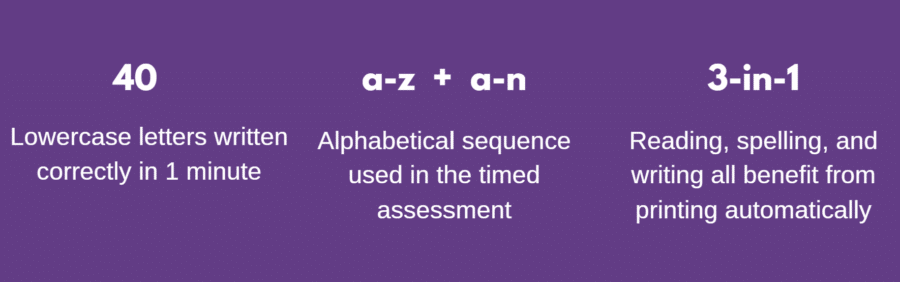
One of our key handwriting benchmarks is this: can your child write 40 lowercase letters — the alphabet a through z, followed by a through n — correctly formed and in order, within one minute?
That might sound like an arbitrary target. It is not.
This benchmark is a measure of fluency, not performance. When a child reaches this threshold, it tells us that letter formation has become truly automatic, that the brain is executing each letter from memory rather than constructing it from scratch. And fluency at this level has measurable, meaningful connections to other literacy skills.
The direct connection to oral reading fluency
Here is one of the most compelling findings in literacy research: there is a direct correlation between a child’s printing fluency — specifically, their ability to write 40 letters per minute correctly formed — and their oral reading fluency.
At first glance, that connection might seem surprising. Reading and writing feel like different skills. But at the foundational level, they share the same building blocks: letter recognition, letter-sound knowledge, and the automatic, effortless retrieval of letter forms. When a child can produce letters fluently by hand, it reflects deep, internalized knowledge of those letters, knowledge that directly supports recognizing them quickly and accurately while reading.
In practical terms: children who reach printing fluency benchmarks tend to read more smoothly, with greater accuracy and expression. They decode less laboriously. They recognize words faster. The automaticity built through handwriting practice transfers directly into the reading process.
The connection in plain language
The more automatic and internalized the letters are, whether producing them or recognizing them, the more fluent your child becomes across all literacy tasks. Handwriting fluency and reading fluency are two expressions of the same underlying letter knowledge
What this looks like in practice
In our sessions, we use Peterson Handwriting Prompts to give every letter consistent, predictable verbal cues. It’s a gentle structure that reduces confusion and builds confidence.
We track formation quality and work toward the fluency benchmark, not by drilling speed, but by building the accuracy and automaticity that make speed a natural outcome.
Progress is visible and measurable. And it tends to show up not just in handwriting but across reading and spelling as well.
How parents can support this at home
Simple routines make a big difference
Daily practice
- 2-5 minutes per day (minimum 2-3X per week) untimed
- Your child may say or sing the letters aloud while writing. Gently assist them as needed to ensure the letters are placed in correct alphabetical order from a-z
- Write lowercase a–z, using the Peterson Printing Prompts to guide your child in correct letter formation
- Focus on correct formation, not speed at first
- If the activity is particularly challenging for your child ease them into it by writing smaller portions of the alphabet.
- Avoid apps for this stage: paper, pencil, guidance wins. A whiteboard also works well to reduce anxiety and make corrections easy.
Cheer accuracy!
Celebrate effort!
1-minute timing
After your child is correctly, quickly writing the alphabet, time their writing for 1 minute.
- Have them write the lowercase alphabet a-z, then restart at a if they finish before time is up.
- Have them write the letters without assistance. They may say or sing the alphabet to themselves as they write.
- Note the number of letters they write.
- The goal is 40 letters (a-z plus a-n)
Follow-up
If the 40-letter goal is not achieved, have your child practice writing the 40 letters untimed 2-3 times per week. Time them again periodically until they achieve 40 letters correctly formed in 1 minute.
Why tracing letters doesn’t work!
You have probably seen worksheets with dotted letters for children to trace. They look helpful, but research shows they do not build the brain pathways needed for fluent handwriting or reading.
What research tells us
Here’s why tracing falls short:
❌ Pencil tracing does not build true motor memory
❌ Children often develop jerky, inefficient movement patterns
❌ Progress in handwriting and reading fluency is slower
Tracing forces the eye to follow a path, but it does not require the child to plan and produce the letter shape. Without that motor planning, the brain isn’t building strong, automatic handwriting patterns.
What to do instead
If your child is struggling with correct letter formation or reversals (confusing b/d, p/q, f/t, n/u, n/z, or m/w) use strategies that actually build neural pathways:
✔️ Finger-tracing first: best for building accurate motor plans
✔️ Rhythmic verbal prompts (Peterson Printing Prompts)
✔️ Hand-over-hand guidance, when needed
✔️ Immediate, gentle correction
✔️ Positive reinforcement and specific praise
These methods help children feel the movement, not just copy a line, leading to smoother, automatic handwriting.
And that matters, because:
Automatic, fluent handwriting supports fluent reading.
The best approach:
Daily alphabet handwriting practice, without tracing. Children form letters from memory, build speed and accuracy, and cement motor planning, all of which strengthen reading skills. Just one minute a day of intentional alphabet writing builds letter automaticity, fluency, confidence, and brain-based reading foundations.
Take the prompts home
We believe that families and tutors work best as a team. To help you support your child’s handwriting practice at home, we are sharing the Peterson Prompts we use in every session, so the same verbal cues, the same letter sequences, and the same consistent approach can continue between appointments.
If you have questions about the prompts, how to use them at home, or where your child is in their handwriting journey, please do not hesitate to reach out.