
“A student’s level of phonological awareness at the end of kindergarten is one of the strongest predictors of future reading success, in grade one and beyond.”
“Strong phonological skills lay a foundation for long-term outcomes in reading fluency and comprehension.”
It is a common assumption that remembering words is a result of seeing them and memorizing sequences of letter names or shapes of words. However, research has proven that the brain stores the vast majority of words by their sound sequence – not by sight!
- The brain maps the pattern of sounds within words for later recall in reading, which means that …
- Strong reading and spelling skills are first and foremost about being able to differentiate sounds, which brings us to …
- Phonological Awareness, which is all about learning to differentiate sounds!
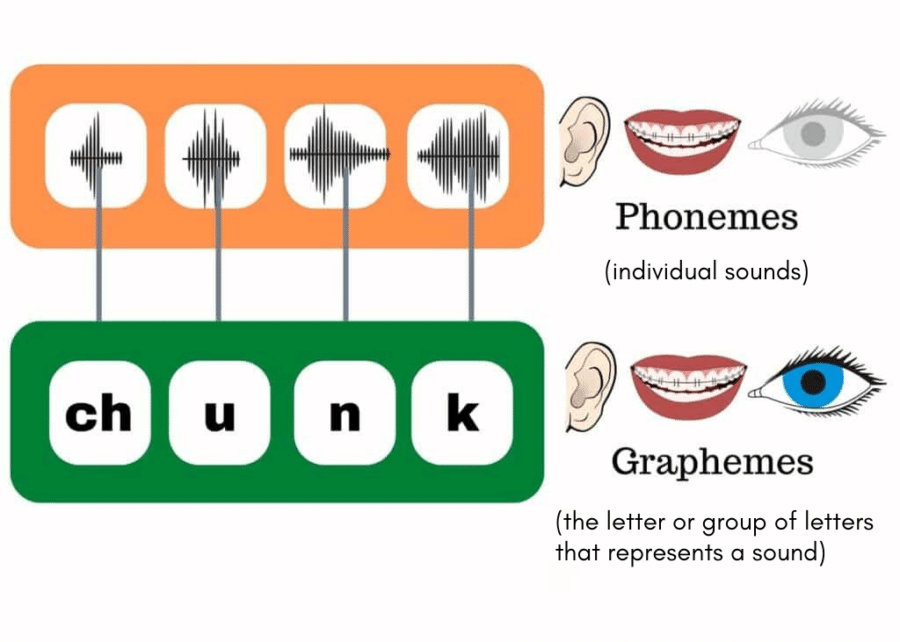
Phonological awareness is the ability to hear, isolate and manipulate or break apart and re-organize phonemes, the smallest units of sound in a word. For example, the word “hat” has three phonemes, /h/- /a/ – /t/, and the word “chick” has three phonemes, /ch/ – /i/ – /ck/.
To recap, the fact that the brain maps sounds for later recall in reading is why phonological awareness is so vital for developing reading skills. Phonemic awareness, the highest level of phonological awareness, is the foundation on which strong phonics skills are built.
The natural continuum of phonological awareness
Phonological awareness develops along a continuum. In terms of natural language development, children first become aware of larger units of sound: syllables, then onset and rime, and finally individual phonemes. This is the sequence observed in oral language acquisition. Children can clap the beats in butterfly long before they can isolate the /b/ sound at the beginning of big.
A quick note on terminology: A syllable is each part of a word with one vowel sound or one opening of the mouth. A phoneme is the smallest unit of sound in a word. Onset and rime, two parts of a syllable, are terms most parents haven’t encountered
The onset is the consonant sound or sounds that come before the vowel. The rime is the vowel and everything that follows it.
In the word cat, the onset is /k/ and the rime is -at. In the word street, the onset is /str/ and the rime is -eet. Not every syllable has an onset — the word at has a rime but no onset — but every syllable has a rime. Children can hear that cat and hat share something before they can fully isolate every individual sound within those words, which is why onset and rime awareness sits between syllable awareness and phoneme awareness on the continuum.
Oral language development of phonological awareness: Syllables > Onset and Rime > Phonemes
But instructional sequence is a different question entirely, and an important one.
The letters of the alphabet and other 2-4 letter combinations represent individual sounds called phonemes: not syllables, not word chunks. So teaching reading by moving through the developmental sequence assumes that how children naturally acquire oral language should determine how we teach them to read. That assumption doesn’t hold up. Oral language development and reading instruction are two different things, and they shouldn’t be treated as the same.
Teaching phonological skills the Linguistic Literacy way
That’s why at Brilliant Futures Tutoring, we start with sounds — not syllables, not word chunks, not the developmental sequence children move through naturally as they acquire spoken language. We start where the code starts.
The approach we use, Linguistic Literacy, is built on a simple but powerful premise: reading is a code, and that code represents individual sounds. So instruction begins there.
Students learn to hear and manipulate the individual sounds in spoken words before connecting those sounds to letters.
Once that foundation is solid, we move to words in sentences, then to multisyllabic words, always moving from speech to print, always anchored in sound.
Phonemic Awareness >
Word awareness in sentences >
Multisyllable words
This is different from following the natural order of phonological development and using it as a roadmap for reading instruction. Children naturally become aware of syllables before phonemes. That’s well documented. But reading isn’t acquired naturally; it’s taught. And what gets taught first should reflect how the written code actually works, not simply mirror the sequence in which oral language skills happen to emerge.
Phonemic Awareness
Phonemic awareness is the most critical phonological skill.
“The lack of phonemic awareness is the most powerful determinant of the likelihood of failure to learn to read.”
Marilyn Jager Adams Beginning to Read: Thinking and Learning About Print (1990)
“Phonemic awareness is more highly related to learning to read than tests of general intelligence, reading readiness, and listening comprehension.”
Keith Stanovich, 1993
Children who lack phonemic awareness are unable to distinguish or manipulate sounds within spoken words or syllables. They would be unable to do the following tasks:
- Phoneme Segmentation: What sounds do you hear in the word hot? What’s the last sound in the word map?
- Phoneme Deletion: What word would be left if the /k/ sound were taken away from cat?
- Phoneme Matching: Do pen and pipe start with the same sound?
- Phoneme Counting: How many sounds do you hear in the word cake?
- Phoneme Substitution: What word would you have if you changed the /h/ in hot to /p/?
- Blending: What word would you have if you put these sounds together? /s/ /a/ /t/
- Rhyming: Tell me as many words as you can that rhyme with the word eat.
Word awareness in sentences
Word awareness is the ability to recognize that spoken language is made up of discrete words. It sounds obvious to a fluent reader, but for young children, speech arrives as a continuous stream of sound. Parsing where one word ends and another begins is a genuine cognitive task.
Word awareness activities include:
- Counting words in a sentence: How many words are in “The dog ran fast”?
- Identifying a specific word: Clap when you hear the word jump in the sentence.
- Manipulating words in a sentence: What would I say if I took the word not out of “I am not tired”?
At Brilliant Futures Tutoring, word awareness is woven into instruction alongside phoneme-level work from the beginning. Students begin by developing strong awareness of individual sounds within words, then expand outward to understand how words function as units within sentences, and ultimately how multisyllabic words are built from those same sound units.
Syllables

A syllable is a word or part of a word with one vowel sound
or one opening of the mouth.
Syllabication is the act, process, or method of forming or dividing words into syllables.
Practical reasons for teaching syllabication
Multisyllable words are presented as early as 1st grade. For students to read new words, develop vocabulary independently, increase comprehension and reading rate they need to be able to decode words of more than one syllable. Syllabication is a word attack strategy for chunking a larger word into smaller parts to make it easier to spell and read.
We teach phonemes first
Children naturally develop syllable awareness early. Clapping the beats in a word — bu ·tter·fly, e·le·phant (linguistic syllable division versus dictionary syllable division) — requires no knowledge of letters or spelling. This is why syllables appear early in the natural developmental sequence of phonological awareness.
But early development doesn’t mean early instruction.
At Brilliant Futures Tutoring, we teach phonemes first. This is the approach used in Linguistic Literacy and EBLI (Evidence-Based Literacy Instruction), and the reasoning is direct: the letters of the alphabet represent sounds, as do many 2-4 letter combinations. These individual units of sound are called phonemes. Starting reading instruction at the phoneme level puts students immediately to work with the actual building blocks of the written code.
Syllable awareness becomes relevant once students have a solid phonemic foundation and begin tackling multisyllabic words.
At that stage . . .
The ability to hear and segment syllables in speech supports students in approaching longer, unfamiliar words — not by applying print-based syllable division rules, but by listening to the spoken word and working from sound to print, which is exactly how Linguistic Literacy approaches decoding.
Syllabication in this context is a speech-first strategy. Students learn to hear the syllables in a spoken word before connecting those chunks to print, consistent with the broader principle that reading instruction should move from speech to print, not the other way around.
Phonics
Phonological awareness is not the same as phonics, though the two work closely together.
Phonological awareness is about sound. Phonics is about the relationship between sounds and the letters or letter combinations that represent them. Once a student can hear and manipulate individual sounds in spoken words, phonics instruction connects those sounds to print, building the bridge between spoken language and the written code.
Traditional phonics instruction typically moves from letters to sounds. Students are shown a letter and taught the sound it makes. Rules are introduced — kinds of syllables, spelling patterns, prefixes, suffixes — and students work through them in a set sequence, one pattern at a time. This approach can be slow, and for older or struggling readers, it often means starting over at the beginning and working through a long checklist of rules before reaching the words they actually need to read.
Linguistic Literacy approaches phonics differently, and the difference starts with direction.
Rather than moving from letters to sounds, Linguistic Literacy moves from sounds to letters. Students begin with spoken words, identify the individual sounds within them, and then learn which letters or letter combinations represent those sounds. The code is introduced in response to real words students encounter, keeping instruction grounded in authentic reading from the start.
This means students spend less time on drills and rules, and more time reading. Many consonant combinations and spelling patterns are encountered and absorbed through authentic reading rather than taught explicitly in advance. The result is faster progress, particularly for older students and struggling readers who need to close the gap quickly, not work through a multi-year sequence from the beginning.
Traditional phonics programs typically follow this sequence:
- Step One: The five short vowels and all consonant combinations spelled by a single letter.
- Step Two: Digraphs, consonants and consonant blends (consonant combinations spelled with two or three letters).
- Step Three: Vowels and vowel combinations spelled with two or three letters.
- Step Four: The five long vowels: v-c-e (mate, mete, mite, mote, mute)
- Step Five: Irregular Spellings.
Linguistic Literacy phonics programs follow a different sequence of instruction
While many traditional phonics programs introduce these sound patterns in isolation, Linguistic Literacy doesn’t follow these five steps in a slow, linear sequence, and it doesn’t explicitly teach every consonant combination before moving forward.
Instead, students begin working with whole spoken words immediately, learning to identify the individual sounds within those words before connecting them to letters. Many consonant combinations are encountered and absorbed naturally through reading real words, rather than drilled in isolation.
For older students and struggling readers, this matters. Rather than starting over at the beginning and working through every sound pattern one by one, Linguistic Literacy moves efficiently. Students are often reading multisyllabic words and authentic text within the first four sessions because the instruction is built on how the brain processes language — from speech to print — not on a checklist of patterns to cover.
In this respect . . .
In this respect, Linguistic Literacy aligns more directly with how the written code actually works and with how the brain processes language — from sounds to letters — from speech to print.