

Let’s Read, a structured resource for parents: how to use it well
What is reading fluency?
Reading fluency is not just reading quickly.

A fluent reader reads:
- accurately
- automatically (smoothly and easily)
- in phrases
- with expression
- at an age-appropriate speed
A fluent reader decodes (reads) so automatically that their mind is free to focus on the message in the reading material.
Let’s Read is a program that can incrementally, systematically develop reading skills.
A linguistic approach
A word family is a group of words that share a common rime unit. The rime unit is the vowel plus any letters that follow it at the end of a word. In the words cat, hat, fat, and sat, the rime unit is “at” (the vowel A plus the letter T).
A linguistic approach to reading instruction uses these rime units and word families as its building blocks. Words that share a rime also rhyme, and that is not a coincidence: the brain stores and recalls rhyming words more easily than unrelated words. Reading word families can reduce the cognitive load for a child who is working hard to decode.
Among linguistics-based readers, ‘Let’s Read’ stands out for its thoroughness and careful progression. It is systematic, confidence-building, and genuinely well-structured for home use. I recommend it to parents and teachers for exactly those reasons.
Note:
The linguistic approach used in ‘Let’s Read’ is not the same as the Linguistic Literacy method of reading instruction.
‘Let’s Read’ organizes words by their rime units and uses that pattern as the primary vehicle for building reading skill.
Linguistic Literacy, by contrast, is a comprehensive, evidence-based literacy program that teaches children to read and spell by working from sound to print: identifying individual sounds first, then mapping those sounds to their spellings.
The two approaches share an interest in language patterns, but they are built on different foundations and serve different purposes.
‘Let’s Read’ is a practice resource.
Linguistic Literacy is a complete instructional system
What’s in ‘Let’s Read’?
There are six parts to “Let’s Read.” Each part builds on the previous one, introducing increasingly complex spelling patterns.
Part 1 contains 36 lessons based on the Consonant-Vowel-Consonant (CVC) spelling pattern, beginning with simple Vowel-Consonant (VC) rimes. Lesson 1 starts with the rime “at.” Part 1 also introduces multi-syllable CVC words, such as “sunset.” Children do not find this overwhelming because they already recognise the CVC pattern and learn to approach the word one syllable at a time. Only the five common short vowel sounds are used: A as in apple, E as in Eddy, I as in itchy, O as in olive, and U as in upper.
Part 2 introduces words like split, lisp, milk, and scram, which are made up of consonant clusters or blends, as well as doubled consonants, some plurals, possessives, and contractions.
Part 3 covers two-vowel combinations, such as ee, ea, oo, and oi, as well as r and y in the final position: patterns that are exceedingly prolific in English.
Parts 4, 5, and 6 progress from there into higher-level text.
Controlled Text
Controlled text is reading material matched precisely to what a student already knows. Every word can be decoded using phonics patterns the child has already learned, or recognized as a sight word. There are no words that require guessing, and no pictures to rely on as a crutch.
“Let’s Read” uses controlled text throughout, moving from rime unit to rime unit in a gradual, sequential progression and giving children a successful experience at each step before introducing anything new.
One honest note
Controlled text programs can slow reading progress when mastery of each lesson is required before moving forward. They also differ from a comprehensive program like Linguistic Literacy in two notable ways: they tend to be more repetitive, and they rely on more explicit, step-by-step instruction at the word level than you would find in a linguistic literacy session.
That explicitness is actually an advantage for home use
The lessons are incremental enough that parents can implement them without additional training. What ‘Let’s Read’ cannot replicate is the accelerated reading progress that comes from Linguistic Literacy instruction, which requires comprehensive professional training to deliver well.
Use it for what it does well: structured, confidence-building practice at home.
‘Let’s Read’ is a practice resource, not a teaching program.
Use it as a supplement to, not a replacement for, structured literacy instruction. Expose your child to the pattern, let them practice it, and keep going. There will be ample opportunities to revisit sounds in later lessons.
One thing to watch for
Here is something I want every parent to understand before using any rime-based program, including “Let’s Read.”
When children learn words by recognizing a rime chunk as a unit, such as reading “cat” by identifying “c” and then the chunk “at,” they are not fully decoding the word.
True decoding means identifying each individual sound, left to right. That habit needs to be built deliberately, and protected throughout.
This is not a reason to avoid “Let’s Read.” It is a reason to use it with one additional layer of instruction. The section below explains exactly how to do that.
The key distinction
Recognizing a rime chunk (“at”) is not the same as decoding each sound (a • t). True decoding goes sound by sound, left to right, every time. Build that habit first, then let the word family structure support fluency.
When is a child ready for “Let’s Read”?
Your child does not need to have mastered every letter sound before beginning. You can teach sound-letter relationships as you work through the book. What matters is that your child is ready to listen carefully for sounds and willing to practice. Everything else can be built along the way.
USING LET’S READ AT HOME
The steps below are designed for parents
The instruction is explicit and the progression is incremental, which means you do not need a background in literacy to follow them. What you are building at home is practice and exposure. The deeper instructional work happens in a structured literacy program.
Read the word lists in columns, not rows
This is an easy-to-miss detail that makes a real difference. Reading down a column, rather than across a row, makes the rime pattern visible and helps children discover the rule themselves. In Lesson 3, for example, reading in columns reveals: change the rime to change the word, or change the final consonant to change the word. Let the pattern emerge rather than telling your child what to look for.
Before your child reads: work through the word list on a whiteboard
Most rime-based programs ask children to recognize words by their pattern. This step does the opposite: it asks your child to build each word sound by sound from the inside out. That is what makes the difference between pattern recognition and true decoding.
Research tells us that red lettering on a white background supports learning best. Therefore, if possible, use a red whiteboard marker on the whiteboard.
How to work through a new word list
- Say the first word aloud.
- Draw sound lines on the whiteboard: one line per sound. Remember that one sound can be spelled with one, two, three, or four letters. The word “mat” has three sounds and three lines. The word “earn” has two sounds and two lines, even though it has four letters.
- Drag your finger beneath the lines as you say the word slowly. Ask: “What is the first sound you hear?” as you tap the first sound line.
- Provide as much support as your child needs. If they struggle to hear a sound, exaggerate it and draw it out. If they still cannot hear it, tell them. Awareness of individual sounds is a skill. Like any skill, some children develop it faster than others. Your job is to teach it, not wait for it to appear on its own.
- Once your child identifies the sound, ask them to write the letter (or letters) that represent it on the sound line, saying the sound as they write. This “say as you write” step is essential. It is not enough for you to say the sound while your child writes. Their brain needs to hear their own voice saying each sound as their hand writes the letter. That simultaneous connection is how sound gets mapped to print.
- If your child does not know how to spell the sound, model it first, then ask them to say it as they write it on their own. Alternatively, write the letters of the word in random order at the top of the whiteboard and ask your child which one makes the target sound. If they do not know, identify it for them.
- Use ‘Peterson Prompts’ as a consistent, easy-to-use reference for how to correctly form letters. The prompts support correct formation by giving your child a consistent, predictable verbal sequence for each letter. It’s a gentle structure that reduces confusion and builds confidence.
- Have your child repeat the prompts and say the sound as they write the letter until forming the letter becomes automatic. For example, “tall down, roll around” /b/. _Peterson_Handwriting_Prompts_BFT.pdf
- Do not use letter names for reading or spelling practice. Sounds only. For the word “bat”: say /b/ not /bee/; say “a as in bat” not “ay”; say /t/ not /tee/. Vowels use the “as in” format because they have multiple sounds. The goal is to connect spoken sound to written form. Letter names get in the way of that.
The only time Brilliant Futures Tutoring uses letter names for emerging or struggling readers and spellers is for a-z handwriting practice a few minutes a day or couple of times per week. See ‘Handwriting Rewires the Brain ‘ for more information.
9. Once the word is written on the whiteboard, ask your child to read it back by saying each sound in order, left to right, then blending them into the whole word.
10. Finally, ask your child to rewrite the word as it would appear in a book: no sound lines, no spaces between letters, saying each sound as they write.
Moving through the rest of the word list
It is not necessary to start from scratch
Once the first word is complete, you do not need to start from scratch for each new word. Here is the sequence for the remaining words:
- Draw sound lines beneath the first word: one line per sound. Leave those lines in place. Adjust the number of lines for each new word as needed.
- Dictate the next word from the list.
- Ask your child to listen for the sound that changes and identify which position it is in. “Which sound changes?”
- The goal is for your child to identify which sound is different, not just that something is different. Manipulating sounds in words, switching one sound out for another, known as phonemic awareness, is critical for developing reading and spelling skills.
- Ask them to erase that letter and say the new sound as they write it in its place,
- Ask them to read the new word.
- Repeat for each word in the list.
Word reading practice
Once your child has worked through each word on the whiteboard, have them read the full word list aloud. Whenever your child gets stuck, provide the answer calmly and keep moving. If they cannot blend the sounds to read a word, work through it together:
Reading sentences
Mark the phrases
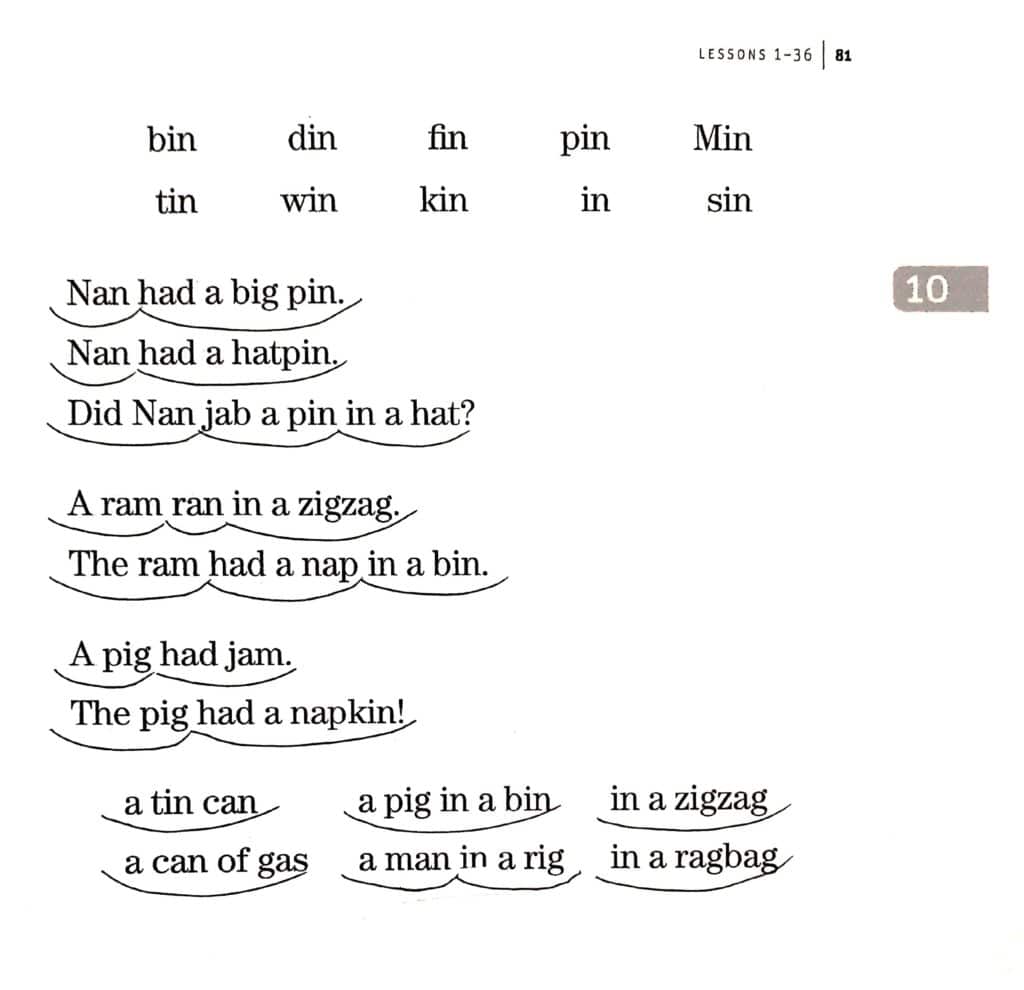
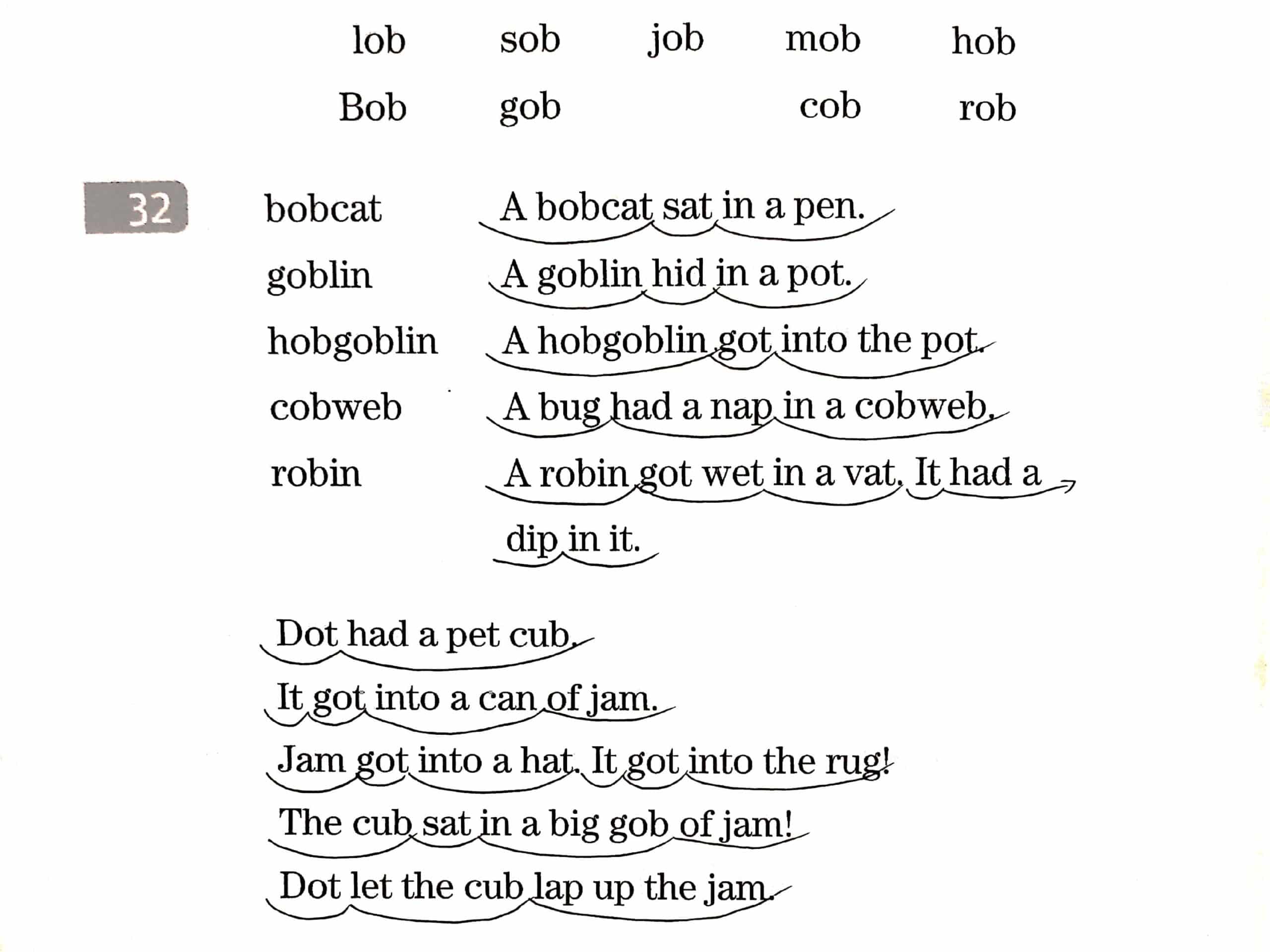
A phrase is a group of words that express a single idea and act as a unit. Reading in phrases, rather than word by word, is essential for comprehension, but it does not come naturally to most struggling readers, even those with strong spoken language skills.
Phrasing and expression are skills to develop over time. Do not expect them immediately.
Mark the phrasing in each lesson by drawing an arc beneath each phrase so that the student can focus their energy on reading. As your child reads, ask them to follow the phrasing with their finger. Basic phrases in Part 1 follow a simple structure: who, did what, where, and any add-on information.
Brilliant Futures Tutoring provides phrase-marked copies of all lessons in Part 1 to our students. If you are not currently working with us, email proof of purchase of “Let’s Read” and we will gladly send you a PDF of Part 1 with all phrases marked.
Each family should purchase their own copy of the book. Please respect copyright and share the marked copy only with your own child.
Model the reading
After your child reads a sentence, model it yourself: read it in smooth, even phrases with expression. Sweep a pencil or whiteboard marker (if the page is in a page protector) beneath the phrases to illustrate the flow. Then ask your child to read the sentence again.
Work one sentence at a time, or a few together if that does not feel overwhelming. The goal is to build stamina, confidence, and accuracy. There is no prescribed number of repetitions.
Acknowledge effort
Be specific with your encouragement.
“Great ‘say as you write.’”
“Nice crisp sound.”
“Your persistence is amazing. You just keep at it!”
Encouragement is not a reward for perfection. Offer it at every opportunity.
TROUBLESHOOTING
My child struggles with blending the sounds to read the word
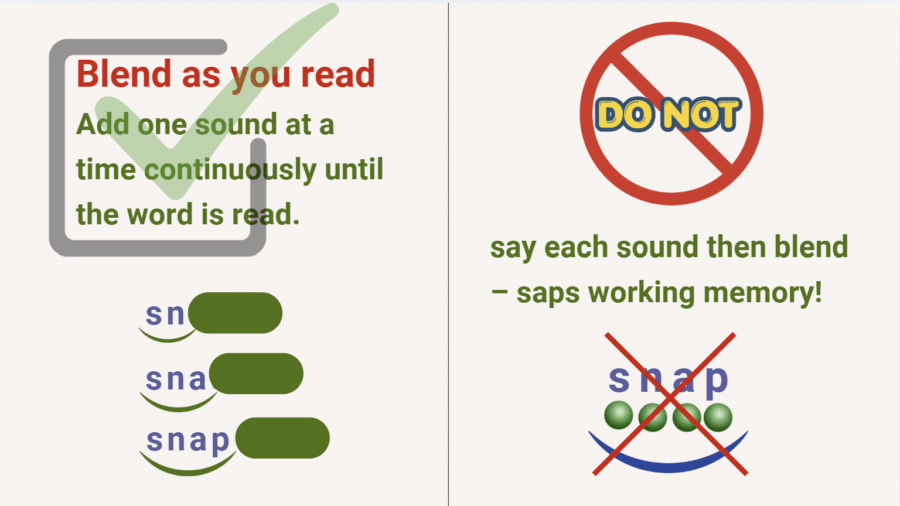
Model blending for your child as you read the word together. Add one sound at a time, continuously, until the word is complete.
Example: “snap”
Sweep your finger under the first two sounds and say /sn/ as you would read them, not /s/ /n/ as separate staccato sounds. Continue adding sounds consecutively: /sna/, /snap/.
Note: staccato (separated) sounds belong in spelling, where each sound must be heard distinctly. In reading, sounds flow together without stopping.
Do not say each sound separately and then blend. That approach saps working memory and makes reading harder, not easier.
Ear training: when your child cannot hear the change
Identifying which sound changes between two words is a skill that does not come automatically to many children. It can be taught directly.
The point is not for your child to find the answer independently. The point is for them to experience the process of isolating, comparing, and replacing sounds, with as much support as they need to get there.
If your child cannot hear the difference between the first word “mat” and the new word “hat,” try this:
- Ask them to tap each sound in the first word as they say it, then do the same for the new word on the sound lines below.
- Isolate the first sound of each word one after the other: /m/ in “mat,” then /h/ in “hat.” Hearing the sounds side by side makes the difference audible in a way that hearing the whole words does not.
- If they still cannot identify the sound that changed, point to the /m/ in mat and then the first sound line below it and ask: “Is /m/ the same as /h/?” If they identify that the sounds are different, confirm it: “/m/ and /h/ are not the same sound, so that is what changed.” Then ask them to erase the /m/ and write /h/ in its place.
- If your child says /m/ and /h/ are the same sound, model both sounds for them. Describe what you notice: where the tongue sits, whether the lips are open or closed, whether the throat is vibrating.
MAKING PRACTICE ENJOYABLE
Use page protectors
Placing lessons inside plastic page protectors lets your child use a whiteboard marker directly on the page to trace the phrase arcs as they read. The colour and smooth flow of the marker can make practice feel more engaging. Page protectors also make it easy to mark sections and keep score for the Read-n-Roll game below without marking up the lesson itself.
Alternatively, cut open the bottom edge of a single page protector and slide it over the lesson page as needed.
Research tells us that red lettering on a white background supports learning best. Therefore, if possible, use a red whiteboard marker for any mark-ups on the page: phrases, dots, spelling.

Read-n-Roll
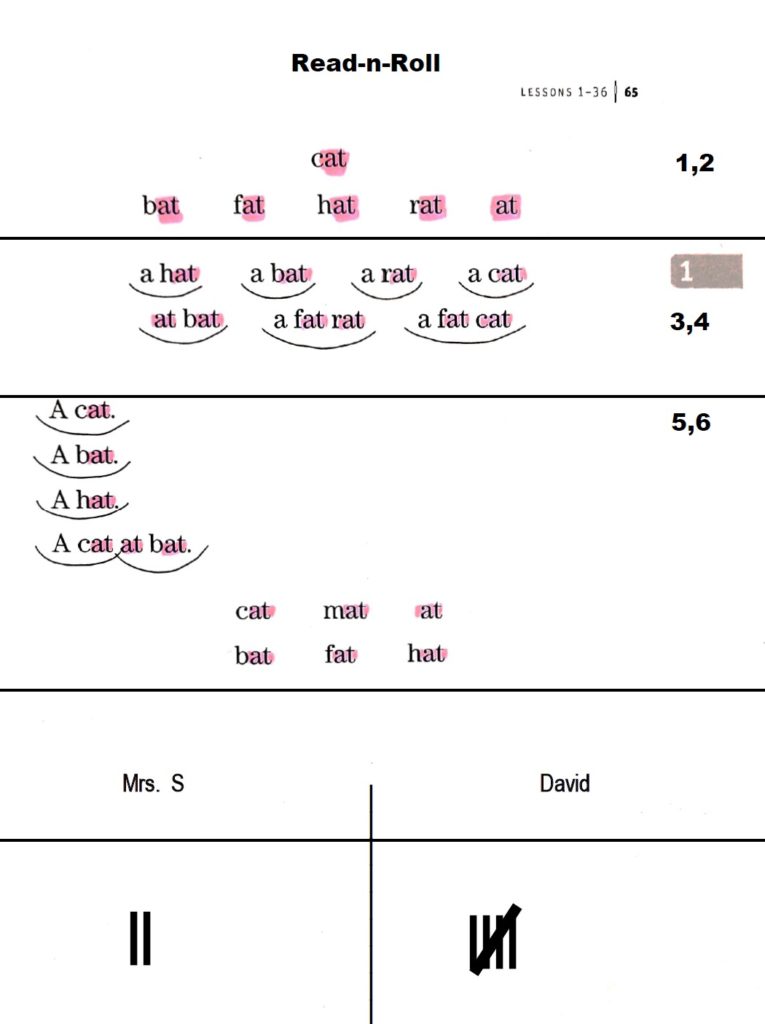
Read-n-Roll is a simple, low-preparation game that turns repetitive reading practice into something a child will actually look forward to. All you need is the “Let’s Read” lesson and a die numbered 1 to 6. A large foam die adds extra fun.
Divide the reading lesson into three sections and assign them numbers: section 1 goes with a roll of 1 or 2, section 2 with a roll of 3 or 4, and section 3 with a roll of 5 or 6. Take turns rolling. Whoever rolls reads the corresponding section and earns points equal to the number on the die. The highest score wins.
Set a limit of three readings per section per player to keep the practice varied. If a player has already reached the limit for the section they rolled, they still earn the points but choose a different section to read.
Add extra actions tied to specific numbers if you like: rolling a 5 means five jumping jacks, rolling a 2 means the other player must follow a Simon Says instruction. Keep it light.
Divide the lesson into three parts. Designate each part 1-2, 3-4, and 5-6, (From personal experience, I found this more effective and efficient than dividing the lesson into 6 parts).
Online games
I have built games for every lesson of Part 1, Part 2, and a few for Part 3. They are free to use at BFT Wordwall
I also recommend wordwall.net as an excellent site for building your own games quickly and easily or accessing free shared activities.
Audio books + eyes on print
A simple and highly effective complement to structured reading practice is pairing audiobooks with eyes on print. As your child listens to a fluent reader and follows along in the book, they are building a feel for how reading sounds before they have to produce it independently. This is a low-pressure, high-value activity that can be done in short bursts throughout the week.
Check out the blog post: Audiobooks + Eyes on Print