
Speech disorders and reading
Reading and spelling lessons for students with speech disorders and apraxia
Specialist 1-on-1 reading tutoring for students with childhood apraxia of speech and other speech disorders. We teach reading and spelling alongside your child’s speech-language pathologist, online across Canada and the US and in person in Prince George.
Speech disorders
How speech disorders affect reading
Some children struggle to read and spell because saying sounds is hard. Two kinds of speech disorders can affect reading. Motor speech disorders, like childhood apraxia of speech, make it hard to plan and coordinate the mouth movements for speech. The child knows what they want to say, but the words don’t come out as planned. Speech sound disorders affect which sounds a child produces and how they organize them. Both are diagnosed by a speech-language pathologist.
Hearing and processing sounds aren’t the core problem with either one. Auditory processing disorder works the other way: hearing is normal, but the brain has trouble making sense of the sounds it hears. That’s covered on our Auditory processing page.
We teach reading
We teach reading and spelling. We don’t diagnose or treat speech disorders. Your child’s speech-language pathologist leads their speech goals, and we work alongside them.
Why apraxia can make reading hard
Saying sounds accurately helps a child identify and remember them. Many children with apraxia find that:
Speech sound disorders
These come in two kinds. Articulation disorders involve trouble producing specific sounds, like r or s. On their own, they usually have little effect on reading. Phonological disorders run deeper. The child’s mental map of sounds is incomplete, so they simplify words in predictable ways, saying “tar” for car or “poon” for spoon. Unlike apraxia, the errors are consistent. Children with phonological disorders may:
Why it works
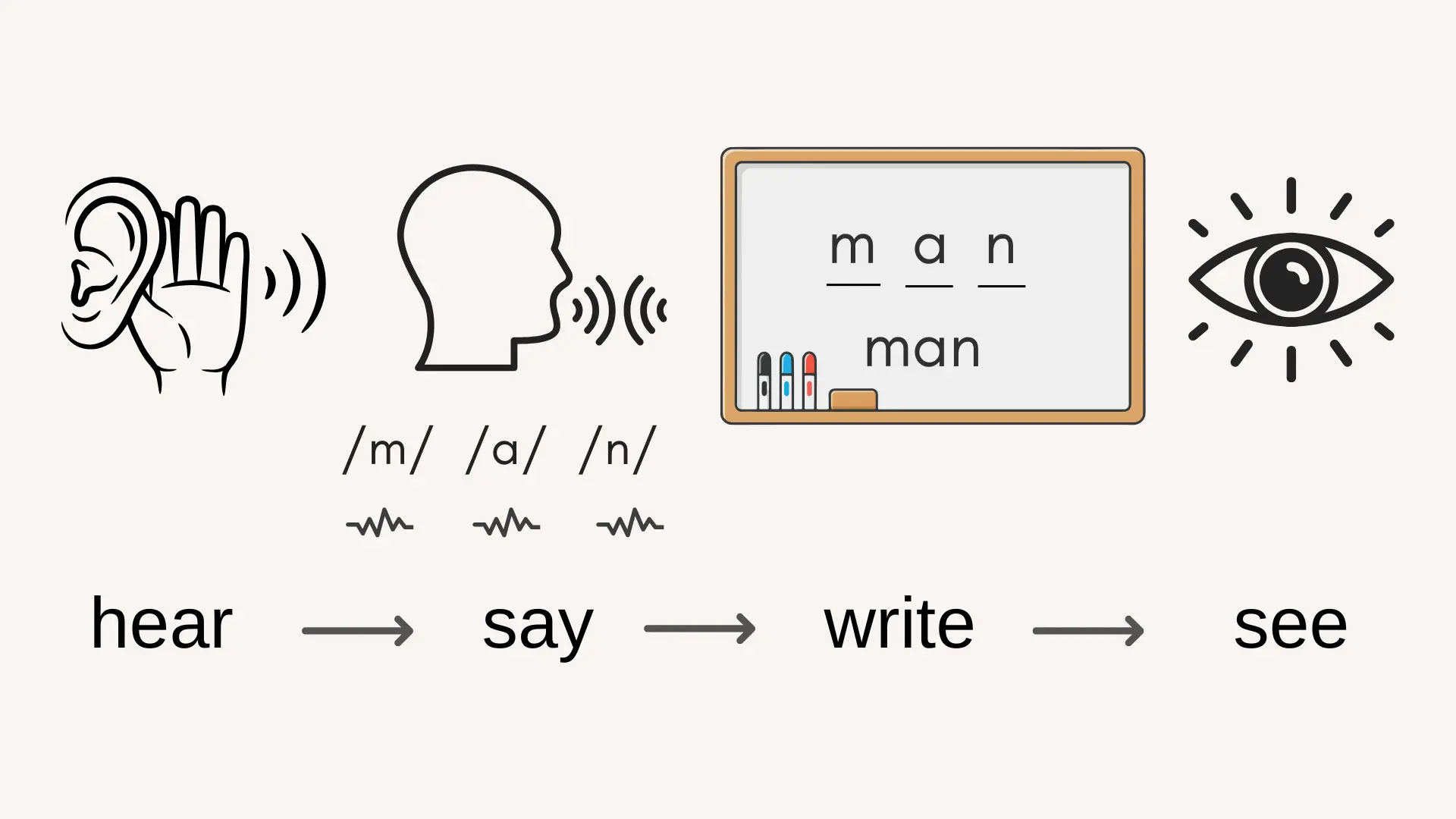
Hear, say, write and see, in every word
Our approach is called speech to print. Each word starts with its sounds: your child identifies each sound in a whole spoken word, matches it to the letter or letters that represent it, says each sound as they write it, then reads the word.
That routine gives patient, structured practice in sequencing sounds, inside real reading and spelling work. There are no spelling or syllable rules to memorize. For students with apraxia, we’ve found physical cues especially helpful. Noticing the shape of the mouth and lips and the position of the tongue helps them feel each sound, not just hear it.
Working together
Your SLP and your tutor, on the same page
With your permission, your speech-language pathologist can see every lesson in our Family Portal: what your child read, the sounds practised and the tutor’s notes.
Home
Upcoming lessons and your action items.
Reading diagnostic
The full baseline, written for parents.
Progress report
Growth, attendance and every lesson in full.
Resources
Practice material and set-up help.
FAQ
Questions families ask
No. We don’t diagnose or treat speech or processing disorders. We teach reading and spelling, and we work alongside the speech and processing professionals who support your child. Our lessons build the sound skills that literacy depends on. In our experience, speech to print helps students with sound processing and speech challenges, because every lesson centres on identifying sounds. When students need extra support, tutors use physical cues, like the shape of the mouth and lips and the position of the tongue, to help them feel each sound.
Not necessarily. Reading and spelling work can run alongside speech therapy. Talk to your SLP, and we are happy to talk it through with you on a discovery call.
Once or twice a week, in a standing 50-minute time slot.
It depends on where your child starts and what they need to reach. Most students see progress in the first few weeks, and substantial progress within several months. Some students reach their goals in about 24 lessons, for example twice a week for 3 months. Most work with us for 1 to 2 years to make those skills secure, with progress measured at the start, middle and end.
Talk to a reading specialist
Book a free discovery call. We will listen first, then tell you honestly how we can help.